Who Is the Father of Lord Shiva? What the Texts Say
Who is the father of Lord Shiva? Two traditions answer differently: Brahma in one Purana, no father at all in another. Here is who says what.
Who is the father of Lord Shiva? The short answer
In short: Who is the father of Lord Shiva? No single name. The Bhagavata Purana has Brahma's anger produce him; Shaiva tradition calls him self-born. Both are tradition, not history.
If you came here for one name to give a child or a relative, I am sorry, there isn't a safe one. What I can give you is the sentence that is true: it depends which text you open, and the most-loved answer is that Shiva has no father because he has no beginning. If the question came up on the way to a shrine, each jyotirlinga has its own page with its own legend, and the planner orders all twelve from your starting town. Nobody is selling you anything here.
Most pages that rank for this question pick a side and say it loudly. I would rather show you where each answer comes from, so that when someone at home says "no, it's Brahma" or "no, he has no father", you know which book they are quoting.
Why the question gets two answers
Start with what you are really asking. "Who is the father of X" is a question that assumes X was born. For most people in most stories, that is a fair assumption. For Shiva it is the very thing the traditions disagree about.
There are, broadly, two ways the texts handle it. One tells a story in which Shiva (under the name Rudra) comes into being, and names who he comes from. The other treats Shiva as the one who was always there, the source of the others, so the question of a father does not arise. Both sit inside the Puranas, the large collections of legend, cosmology and pilgrimage that tradition has handed down. They were not written by one person or in one century, and they do not try to agree.
Two traditions, two answers to the same question
| Tradition | What it says of Shiva's origin | Who the "father" is |
|---|---|---|
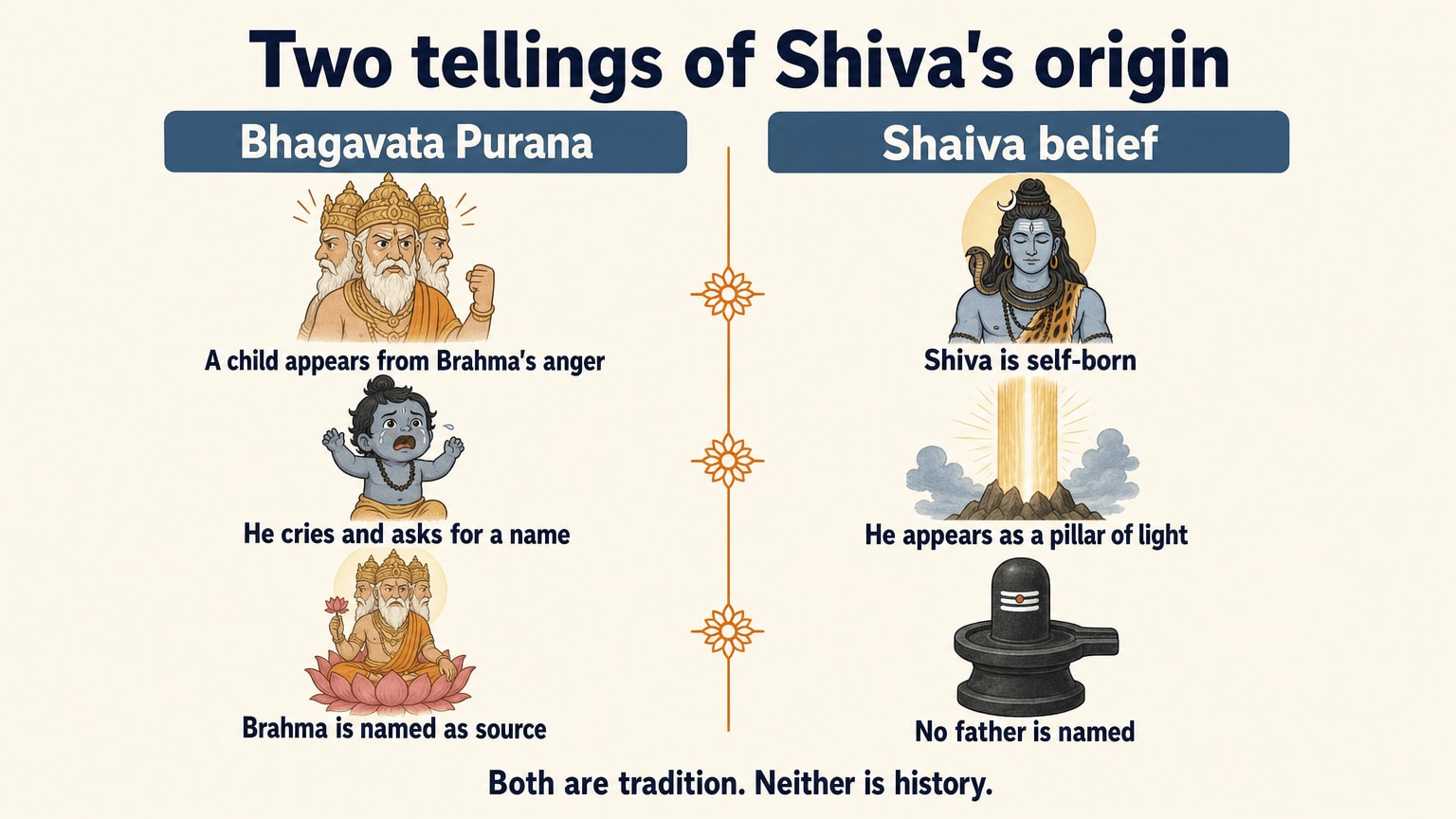
| Bhagavata Purana (canto 3, chapter 12) | Rudra appears as a child from Brahma's anger | Brahma, in that telling |
| Shiva Purana (Vidyesvara Samhita, as retold) | Formless Shiva appears as a pillar of fire that Brahma and Vishnu cannot measure | No father: Shiva is not shown as born |
| Shaiva belief generally | Shiva is svayambhu, self-born or self-existing | None |
Source: Vedabase, Bhagavata Purana 3.12, Boloji on the Shiva Purana, Wikipedia, Svayambhu
I will say now what I could not do. I could not open the text of the Shiva Purana itself and read, word for word, a verse that says "Shiva has no beginning". The retelling I could read shows him as formless, then as a pillar of fire neither god can measure. It does not state the beginninglessness outright. Other pages claim chapter and verse for it, but they also say they did not check, so I have not borrowed their numbers.
The Bhagavata Purana: Brahma's anger and a crying child
This is the telling people usually mean when they say Brahma is Shiva's father, and it is worth reading the verses rather than the summaries.
In the third canto, Brahma is creating the world, and things go badly. Verse 3.12.7 says that although he tried to curb his anger, it came out from between his eyebrows, and a child mixed blue and red was immediately generated. That is the child tradition identifies as Rudra, Shiva.
The next verse is the one I find hard to forget. After his birth the child began to cry, and asked Brahma, the destiny maker, to designate his name and place. A newborn that wants a name and a seat in the world. It is a very human picture, and quite unlike the dancing, fire-ringed Shiva on a poster.
So in this one telling, a birth is described, and the one he is born from is Brahma. If someone says "Brahma is the father", this is the passage they have in mind.
Two cautions. The first: the verse says Rudra comes from Brahma's anger, between the eyebrows. It does not use the word "father" in the way a family would. That is a reading, and a common one, not something I can hand you as the text's own phrase. The second: this is one chapter of one Purana. It is not the whole of what tradition says, and it is certainly not history.
The Shiva Purana: no father, no beginning
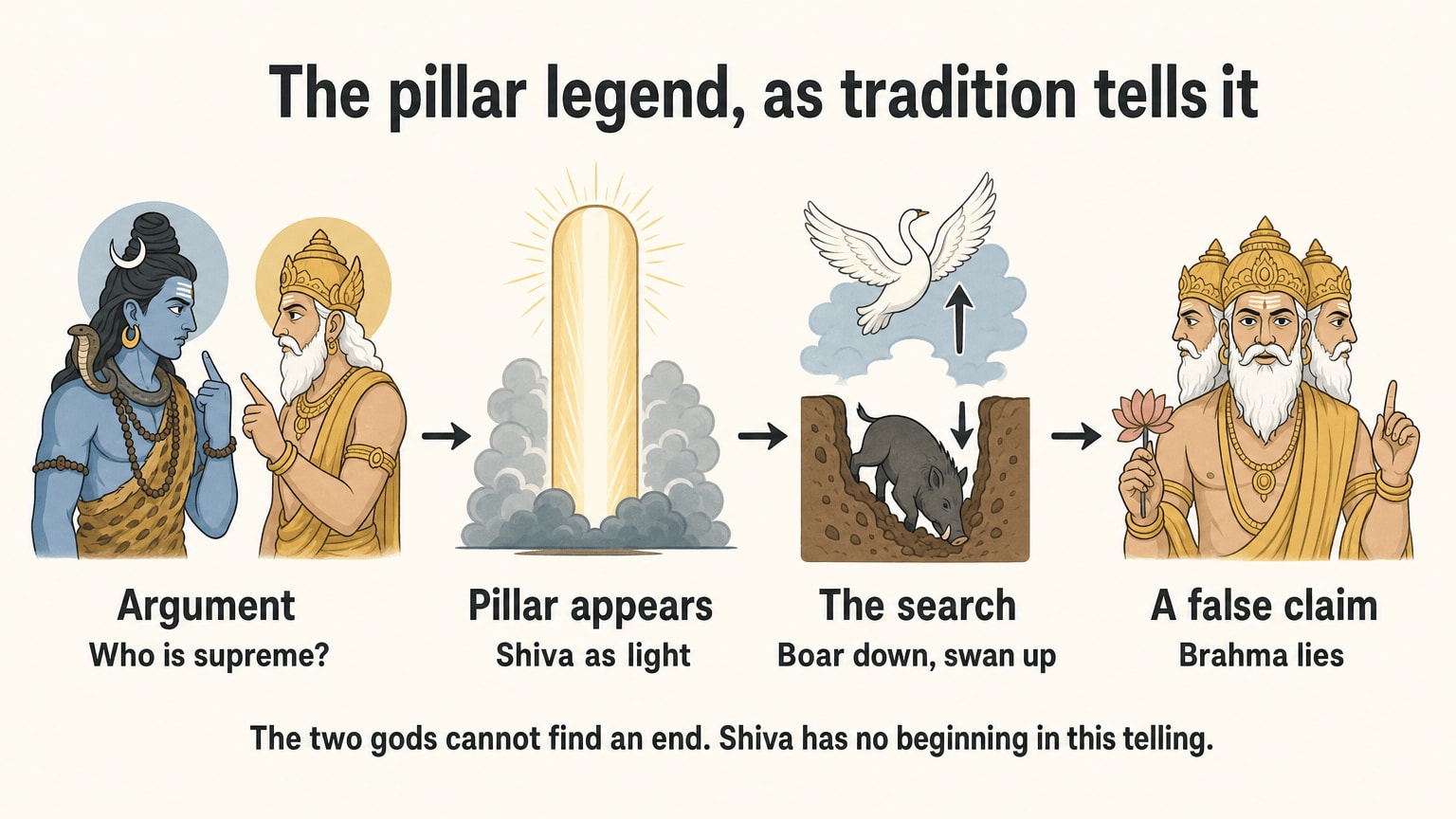
Now the other answer. In the Shiva Purana, as retold in a summary of its Vidyesvara Samhita, Brahma and Vishnu fall into an argument about which of them is greater. The argument turns into a fight, and the gods of heaven watch. Then formless Shiva transforms himself into a massive pillar of fire.
Vishnu becomes a boar and goes down to find the root. Brahma becomes a swan and flies up to find the top. Vishnu comes back honest and empty-handed. Brahma claims he saw the top, with a ketaki flower as his witness. Shiva reprimands Brahma for the lie and honours Vishnu for the truth.
Look at who is in this story. Brahma and Vishnu are the two who are not sure of their rank, and Shiva is the one who does not fit inside a measurement. In this telling Shiva is not the junior member of a family. He is the thing the others cannot get to the end of. Wikipedia sums up the Shaiva position the same way: in Shaivism, Shiva is the Supreme Lord who creates, protects and transforms the universe. You do not ask who the father of the creator is. The question has nowhere to land.
That is the sense in which devotees say Shiva is svayambhu. The word is Sanskrit and, according to Wikipedia, means self-born, self-manifested or self-existing. Keep that word. You will see it again at the shrines.

Family that is named: Parvati, her parents, the sons
There is one set of parents the texts are happy to name, and they are not Shiva's. Parvati, his wife, is the daughter of Himavat and Mainavati, whom many families know as Himavan and Mena. The mountain king and his queen have a father-in-law's role in the story, not a father's.
Shiva and Parvati have two sons, Kartikeya and Ganesha, per the same reference. Wikipedia's Shiva article gives the same two children.
So the family on the wall at home has a lopsided shape. Shiva's wife has named parents, his sons have named parents, and the head of the household has none in the account most devotees keep. That is not an oversight. It is the point the tradition is making.
I will not tell you what each telling of Ganesha's birth says here, because I did not source one, and the tellings are not the same.
What historians say, separately from devotion
There is a third voice, and it is not a devotional one. Wikipedia notes that Shiva may have non-Vedic roots, and that he appears to be an amalgamation of various older non-Vedic and Vedic deities, linked to the Vedic storm god Rudra.
That is a scholar's way of saying: when you trace the figure back, there is no father to find because there is no single person to trace. A god who grows out of several older ones has a history, but not a birth certificate. I mention it because some readers want this angle and it does not conflict with the others. Devotion says self-born. A scholar says a composite. Neither of them says "his father was X", and that is itself worth knowing.
Why two answers can both stand
It bothers people that the books disagree. It bothered me for a bit, and then I stopped asking it as a contest.
A Purana is not a biography. Each one is written from inside a devotion. A text that wants to praise Brahma as the maker of the world has a reason to show Rudra coming out of him. A text that wants to praise Shiva as the highest has a reason to show Brahma and Vishnu failing to reach his ends. Each is doing its own job. I am reading motive into them here, and I say so: I did not find a source that explains why the texts differ. It is only how I make sense of what I could read.
What matters for you is the label. When someone gives you an answer, ask "from which text?" That one question ends most of the family arguments, because both people are usually right about their own book.
There is also a plain reason not to force one answer. The site's own story of why the twelve formed does the same thing with the number twelve: it tells the legend, says where it comes from, and says where I found no reason at all. Honest gaps are better than a neat answer that is not there. Here the neat answer would be a name. There isn't one.
Four things people get wrong
These come up whenever the question is argued in a family group chat.
"Brahma is definitely his father." Only in one telling. The Bhagavata passage above describes a birth from Brahma's anger, and that is all. Another tradition shows Brahma as the one who lies in front of a pillar of light and is cursed for it. Wikipedia's account of the legend says Brahma was barred from having temples of his own after the lie. The same Brahma being Shiva's father and Shiva's judge is a lot to hold at once, which is a clue that these are separate stories.
"No text ever gives Shiva a birth." Also too strong. The Bhagavata verses give one. What is true is that the Shaiva tradition does not rest on that birth.
"Shiva is older than Brahma and Vishnu, so he must be their father." The pillar legend shows them unable to find his ends. It does not say he made them. The retelling I read says only that the two cannot reach the top or the root.
"If he has no father, he is not real to the tradition." The opposite. Not having a father is how the tradition says he is without beginning. It is a statement of reverence.
The pillar of light and the jyotirlinga
This is where the question meets the shrines, and where a pilgrim should care.
The legend of the pillar is the story behind the word jyotirlinga: Shiva appearing as a column of light. I have written about that on this site already, in why the twelve formed, including the tradition that the Shiva Purana mentions 64 and holds 12 most sacred. Wikipedia's page on the Lingodbhava legend gives the outline: Brahma and Vishnu argue over which is superior, Shiva appears as a massive pillar of light, Vishnu searches as a boar, Brahma as a gander, and Brahma lies.
Now put the two together. If the jyotirlinga is the place where Shiva appeared as that endless light, then a jyotirlinga is, by its own story, a place where the question "who made him" is answered by the shape in front of you. No face, no body, no parents. A plain rounded pillar. Wikipedia's article on svayambhu even uses the twelve jyotirlinga images as its example of a self-manifested murti, one that is, in its words, not of human creation.
That is also why a lingam is described as aniconic: no face or body. A family scene in a poster shows Shiva with Parvati and sons. A lingam shows what the tradition says came first, without one.
Each shrine has its own legend of why Shiva stayed there, and the shrine pages give them one at a time. The full stories of each shrine say where the tellings differ. Please do not read one shrine's story or its rules as the rule for all twelve. They differ. The pages carry timings last checked on 13 August 2026, and timings change, so confirm on the official portal before you travel. If you want a list or map to print, the downloads page has them, free, with nothing gated. If you are weighing up the whole circuit, there are separate posts on how many days the full yatra takes and what it costs.
So what do you tell a child?
I keep coming back to a plain sentence, and I would use it myself.
"Some stories say Shiva was born from Brahma's anger. Most devotees say he was never born at all: he was always there, and that is why we call him self-born."
It is true to what the texts say, it names no one as the answer, and it does not pretend the stories agree. A child can follow it. A grandparent will probably nod. A scholar will not argue with it, because it is attributed.
What I would not say is "the Puranas prove" either. Legends are tradition. They tell you what people have believed and why, and that is already a lot.
Frequently asked questions
Who is the father of Lord Shiva in the Puranas?
It depends on the Purana. In the Bhagavata Purana (3.12.7 and 3.12.8), a child generated from Brahma's anger, between his eyebrows, is the one tradition identifies as Rudra, Shiva. In the Shiva Purana, as retold, Shiva appears as a pillar of fire neither Brahma nor Vishnu can measure, and he is not shown as born.
Is Brahma the father of Shiva?
In the Bhagavata telling, Brahma is the one the child is born from. In the Shiva Purana legend of the pillar, Brahma is the god who lies and is cursed. So "Brahma is the father" is true of one passage, not of the tradition as a whole.
Does Lord Shiva have a mother?
I could not source a named mother for Shiva in anything I could read, and I will not invent one. The Bhagavata verse describes a birth from Brahma's anger, with no mother named. Shiva's wife, Parvati, has named parents, Himavat and Mainavati.
What does svayambhu mean?
It is a Sanskrit word for self-born, self-manifested or self-existing. It is used for deities, and for images said to be not of human creation. Wikipedia gives the twelve jyotirlinga images as examples.
Why does Shiva have no parents in some stories?
Because in Shaivism he is the Supreme Lord who creates, protects and transforms the universe. A being with no beginning has no father. That is a theological claim from the tradition, not a fact of history.
Is any of this historical fact?
No. These are legends and beliefs, passed down as tradition. A scholar's view, per Wikipedia, is that Shiva may combine older Vedic and non-Vedic gods, which is a different kind of statement again.
Which jyotirlinga should I read about first?
Whichever you are travelling to. Start with the shrine's own page, for example Somnath or Kedarnath. Kedarnath's opening dates change every year, so check before you plan.