Sugam Darshan
A paid queue-less darshan, escorted by a shastri assistant — roughly ₹250 per person. Worth it on Mondays, through Shravan and on any festival day.
shrikashivishwanath.org ↗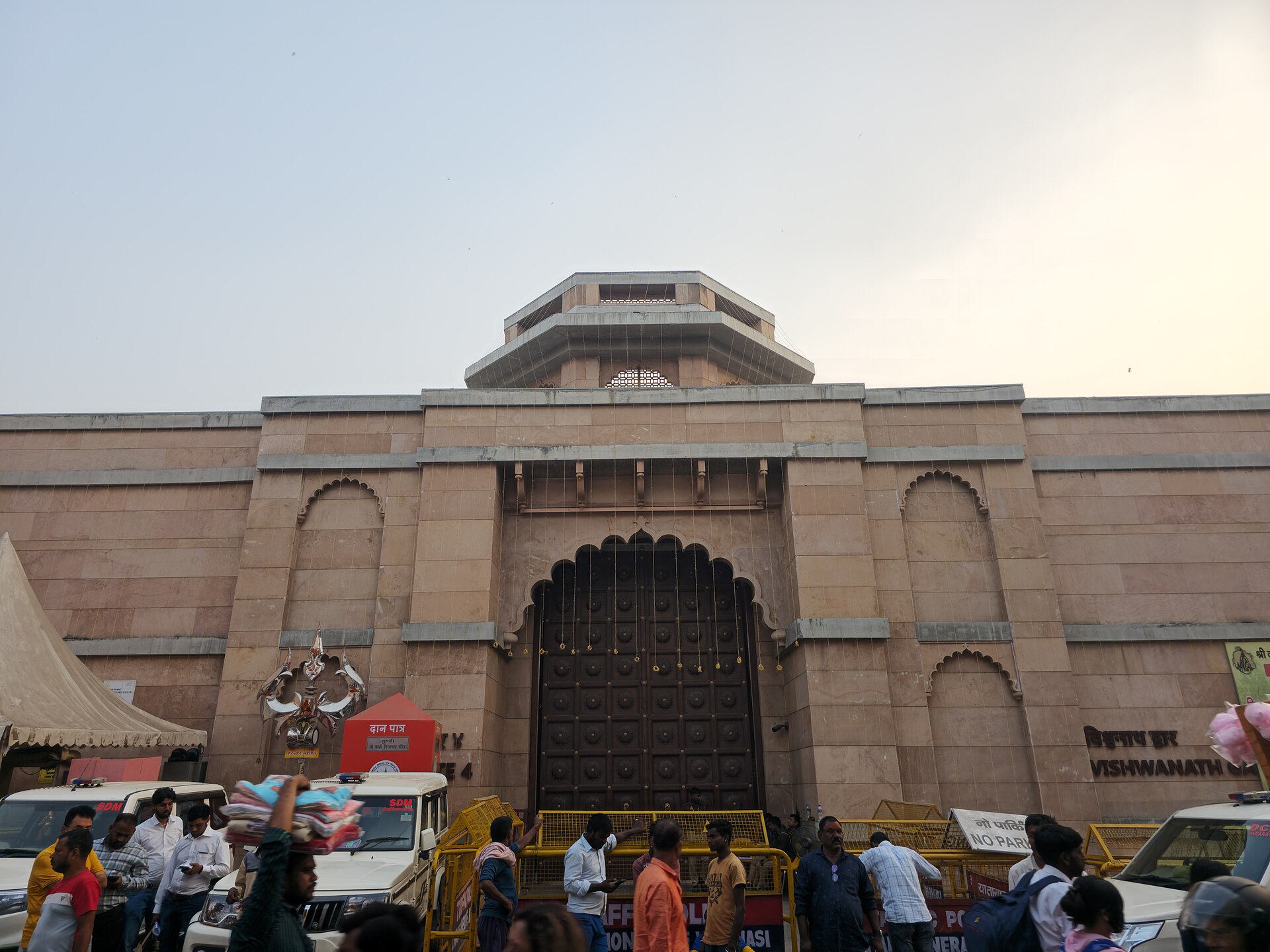
Kashi is said to rest on the tip of Shiva's trident, untouched by the earth and unaffected by its dissolution. At its centre stands Vishwanath — Lord of All — and at the ear of the dying, Shiva himself is said to whisper the mantra of liberation.
Older than history, they say.Older than tradition.Older even than legend.
Why Shiva is here, and not somewhere else — as the Shiva Purana and local tradition tell it.
When the universe dissolves, everything returns to water — everything except Kashi. Shiva holds it aloft on his trishul, above the flood. So the city is called Avimukta: never abandoned, never forsaken, not even by the end of the world.
It is said that Shiva speaks the Taraka mantra into the ear of anyone who dies within Kashi, and that this alone breaks the cycle of rebirth. It is why the old and the dying still come here to wait, and why the fires at Manikarnika have not gone out in living memory.
The temple was demolished and rebuilt across centuries; the present structure was raised by Ahilyabai Holkar of Indore in 1780, and its gold spires plated by Maharaja Ranjit Singh. The Kashi Vishwanath Dham corridor, opened in 2021, cleared the crush of lanes and finally connected the shrine to the river it had always faced.
Times shown in IST. The status above is live against the temple's published hours.
One of the longest darshan days of any Indian temple. Darshan halts during each ticketed aarti. The Dham entry gates and free mobile-phone lockers open before the temple does.
What can be booked, what is free, and where the official channel actually is.
A paid queue-less darshan, escorted by a shastri assistant — roughly ₹250 per person. Worth it on Mondays, through Shravan and on any festival day.
shrikashivishwanath.org ↗Mangala, Bhog, Saptarishi and Shringar aartis are all ticketed and must be booked ahead — Mangala especially. Book only on the official portal or the temple app.
Official booking ↗During Shravan the temple runs a separate booking calendar with blackout dates. Check the portal notice before planning a Shravan visit.
Shravan calendar ↗Dhoti-kurta or ordinary trousers and shirt — Indian dress is not compulsory and western clothing is allowed. Shorts are not.
Saree, salwar-kameez or kurti with leggings. Shoulders and knees covered. A dupatta for the head inside the sanctum is customary.
Varanasi, on the Ganga, Uttar Pradesh — 25.3109°N, 83.0107°E
Direct flights from Delhi, Mumbai, Bengaluru and Kolkata. Taxi to the Dham takes about an hour in traffic.
Major junction on the Delhi–Kolkata line. Banaras (BSBS) and Mughalsarai / DDU (~18 km) also serve the city.
Well connected to Lucknow (~300 km), Allahabad/Prayagraj (~120 km), Gaya (~250 km) and Patna (~250 km). The lanes near the Dham are pedestrian only — vehicles stop well short.
October to March is the season — cool mornings, clear evenings on the ghats. April to June is very hot. The monsoon raises the Ganga and can submerge the lower ghats, though the temple stays open throughout.
The Ganga Aarti at dusk — fire, bells and several thousand people, every single evening.
Shiva's consort as the goddess who feeds. Traditionally visited alongside Vishwanath.
The kotwal of Kashi. Older devotees say his permission comes before Vishwanath's darshan.
Where the Buddha gave his first sermon. A completely different silence, half an hour away.
Freely-licensed photographs from Wikimedia Commons. Each is credited to its photographer.


Pilgrimage vlogs from independent travellers on YouTube — the walk in, the queue, the darshan. Nothing loads until you press play.
Light a lamp for Kashi Vishwanath and it stays lit across the site — your progress towards all twelve is remembered on this device.