12 Jyotirlinga Yatra Cost in 2026: A Real Budget Breakdown
Quotes for the same yatra run from Rs 10,500 to Rs 1,48,450 — a fourteen-fold spread that nobody explains. Here are the official temple rate cards, the real IRCTC fares, what private operators leave out, and what it actually costs to do it yourself.

Kedarnath. The single most expensive line in almost every 12 Jyotirlinga budget — and the one most often quietly dropped from the cheap packages. Photo: Rohit Sharma · CC BY-SA 4.0 · Wikimedia Commons
Contents
- The short answer
- Why the quotes vary fourteen times over
- The two IRCTC trains, and why one costs seven times the other
- What you actually pay at the temple gate
- The Bhasma Aarti arithmetic
- Trimbakeshwar pujas: where the real spending happens
- Kedarnath: the leg that breaks every budget
- Doing it yourself: the real numbers
- What is not in the quote
- A worked example
- What pilgrims ask
- Sources and how much to trust them
Search for "12 Jyotirlinga tour package" and within about ninety seconds you will have collected quotes of ₹10,500 and ₹1,48,450 for what is described, in both cases, as the same pilgrimage.
That is a fourteen-fold spread. Chaudah percent ka fark nahi — chaudah guna. And not one of the pages quoting those numbers explains why.
I went and got the actual figures: the official rate cards published by the temple trusts themselves, the IRCTC Bharat Gaurav fare bands, the quotes from five private operators, the regulated helicopter fares, and the road distances that drive most of the cost. Some of it is verifiable to the rupee. Some of it genuinely isn't, and I have said so where that's the case rather than filling the gap with a confident guess.
Ek baat pehle hi saaf kar dete hain: nobody is selling you anything on this page. There is no booking form at the bottom.
The short answer
For a full twelve-shrine yatra in 2026, budget roughly:
- Doing it yourself, 18–21 days, sleeper class and dharamshalas — ₹30,000 to ₹50,000 per person
- A mid-range private package — ₹55,000 to ₹90,000 per person
- A flight-heavy premium package — ₹95,000 to ₹1,60,000 per person
Those three bands are derived from published operator tiers rather than from a surveyed sample of actual trips — the section on doing it yourself shows the working.
And the single most useful thing on this page: IRCTC runs two different Bharat Gaurav Jyotirlinga trains, at wildly different prices, and both of them cover seven shrines, not twelve. The ordinary train starts at ₹17,600. The Deluxe AC train runs to ₹1,34,255 — more than most twelve-shrine private packages. Almost nobody states either fact plainly.
Temple entry itself is a rounding error. Somnath charges nothing at all. Grishneshwar charges no entry fee. The most expensive official darshan ticket among the twelve is ₹750. What costs money is getting there — about 8,230 km of it.
Why the quotes vary fourteen times over
Here is the spread, plotted. Every figure is a real published price from a real operator, collected in August 2026.
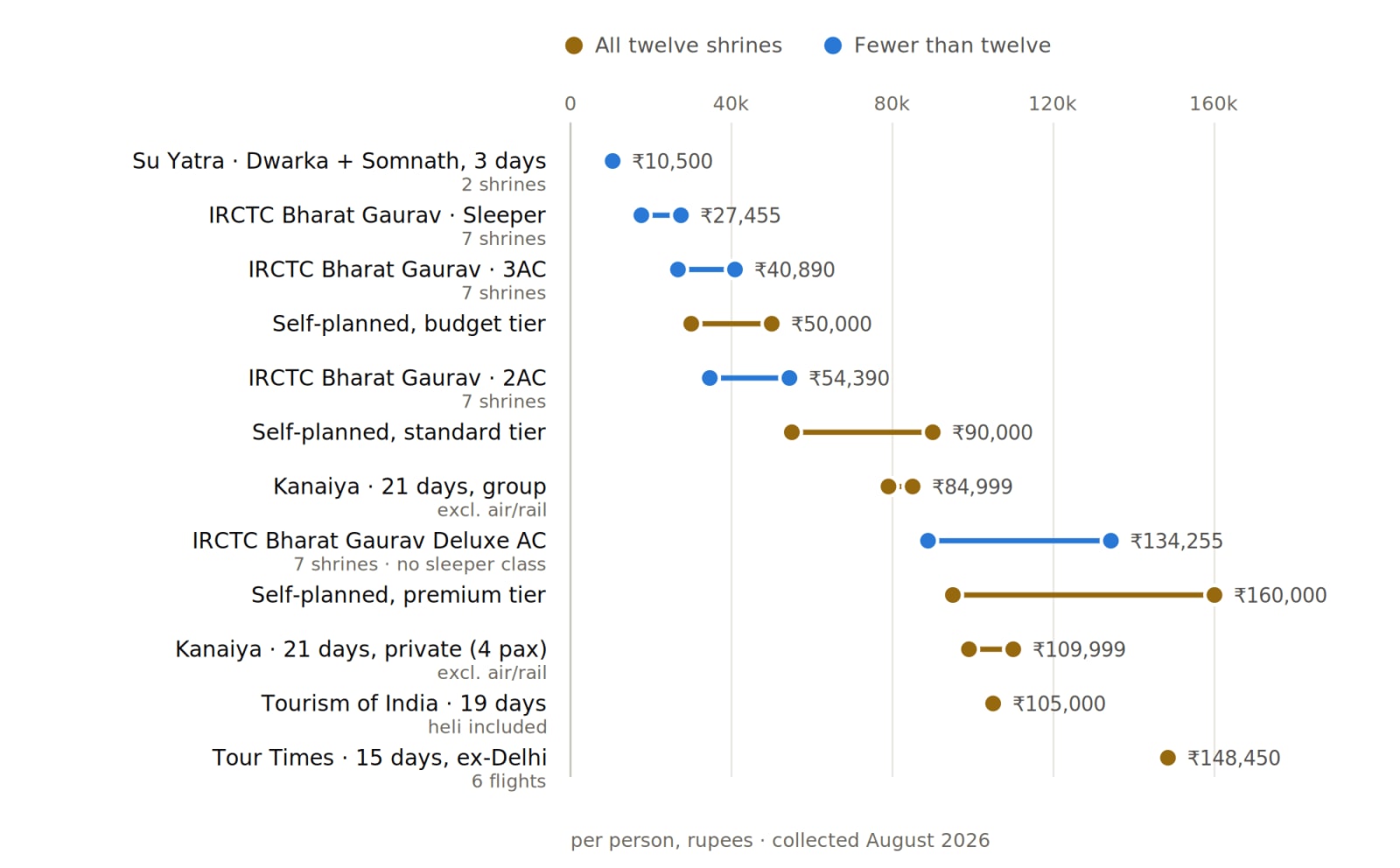
Published per-person prices, August 2026. Ranges are shown where the operator quotes a band; the shrine count is marked because it is the thing that actually differs. Note that IRCTC's Deluxe AC train covers seven shrines for nearly the price of a twelve-shrine private package.
Ek baar samajh aa jaaye toh yeh spread bilkul mysterious nahi lagta. Chaar cheezein poora fark bana deti hain:
1. How many shrines are actually included. The bottom of that chart is not a bargain, it is a different trip. Su Yatra's ₹10,500 is a three-day Dwarka–Somnath package covering two Jyotirlingas. Both IRCTC trains cover seven. Only some of these packages genuinely do all twelve. Sabse pehle shrine list check kijiye — hotel category se pehle, inclusions se pehle, sab se pehle.
2. Whether flights are in or out. Rameswaram to Varanasi is 2,361 km by road — around forty hours of driving. Deoghar to the Kedarnath roadhead is another 1,485 km. Any operator doing all twelve either flies those legs or spends four days on them. Tour Times' ₹1,48,450 package includes six flights and two Vande Bharat legs; Kanaiya's ₹78,999 quote explicitly excludes air and rail.
3. Whether Kedarnath is really included. Kedarnath is 16 km on foot each way from Gaurikund, or a helicopter. That is a genuine cost and a genuine risk, and the cheaper packages tend to quietly drop it.
4. Group versus private. Kanaiya's own pricing makes this cleanly visible: ₹78,999–84,999 per person for a group departure on twin-sharing, against ₹98,999–1,09,999 per person for a private trip with four passengers. Same 21 days, same itinerary, roughly 25% more.
The rule of thumb: if a 12-Jyotirlinga quote is under ₹25,000, check the shrine list before you check anything else. Aksar woh saare baarah hote hi nahi hain.
The two IRCTC trains, and why one costs seven times the other
This is the section to read if you read nothing else.
IRCTC runs two separate Bharat Gaurav products on this circuit, and both of them cover seven of the twelve — Mahakaleshwar, Omkareshwar, Nageshwar, Somnath, Trimbakeshwar, Bhimashankar and Grishneshwar. The catalogue name on one of them is literally Sapta Jyotirlinga Mahayatra. Sapta. Saat. Baarah nahi.
The five they do not cover are Kedarnath, Kashi Vishwanath, Vaidyanath, Mallikarjuna and Ramanathaswamy — which is to say, all of the geographically awkward ones. That makes complete sense as a rail product and is not in any way dishonest of IRCTC. Dikkat yeh hai ki bahut saari third-party sites ise "IRCTC 12 Jyotirlinga package" bolkar bech deti hain, aur log yeh samajh kar book kar lete hain ki poora ho jayega.
What almost nobody explains is that the two trains are priced in different universes.
The ordinary Bharat Gaurav Tourist Train — the one with a sleeper option:
| Class | Adult | Child (5–11) |
|---|---|---|
| Economy (Sleeper) | ₹17,600 – 27,455 | ₹16,300 – 22,720 |
| Standard (3AC) | ₹26,700 – 40,890 | ₹25,200 – 39,260 |
| Comfort (2AC) | ₹34,600 – 54,390 | ₹32,800 – 52,425 |
The Bharat Gaurav Deluxe AC Tourist Train — no sleeper class at all, AC-1 / AC-2 / AC-3 only:
| Occupancy | Fare |
|---|---|
| Triple sharing | from ₹88,810 |
| AC-1, single coupe | up to ₹1,34,255 |
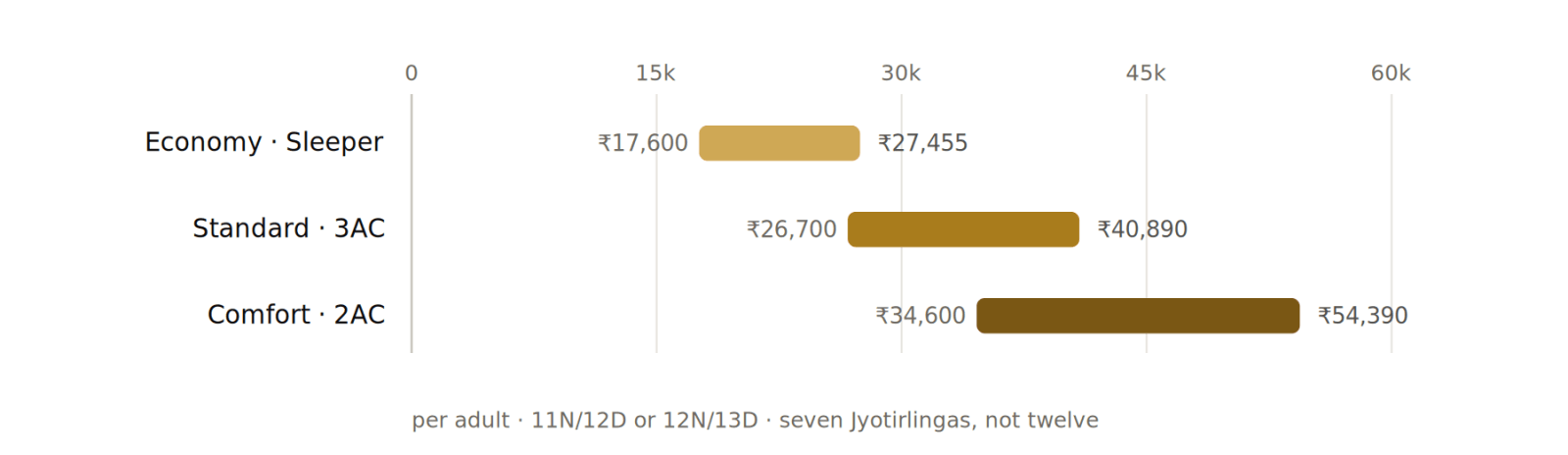
The ordinary train's three classes. The Deluxe AC product sits entirely off the right-hand edge of this chart, starting at ₹88,810.
Read those two tables together and the article's whole thesis is right there: a seven-shrine Deluxe rail package at ₹1,34,255 costs almost as much as Tour Times' fifteen-day, six-flight, twelve-shrine package at ₹1,48,450. Quote compare kar rahe hain? Pehle shrine count dekhiye, comfort baad mein.
Included on both: vegetarian meals, accommodation, road transfers, travel insurance and taxes. Not included: temple entry and any special-darshan charges. Indian Railways advertises a concession of up to roughly 33% on Bharat Gaurav bookings.
Source caveat, stated plainly: IRCTC's own package pages render client-side and do not serve their prices to a plain fetch, so none of the figures above come directly from irctctourism.com. The ordinary-train bands are reproduced from a secondary source and corroborated against a news report of a September 2026 departure (Economy ₹24,100 / 3AC ₹40,890 / 2AC ₹54,390). The Deluxe figures come from press coverage of a 25 September 2026 Delhi Safdarjung departure. Fares also vary by boarding city and date. Confirm on irctctourism.com before booking.
What you actually pay at the temple gate
Ab yeh baat zyadatar logon ko chaunka deti hai: mandir khud almost free hain.
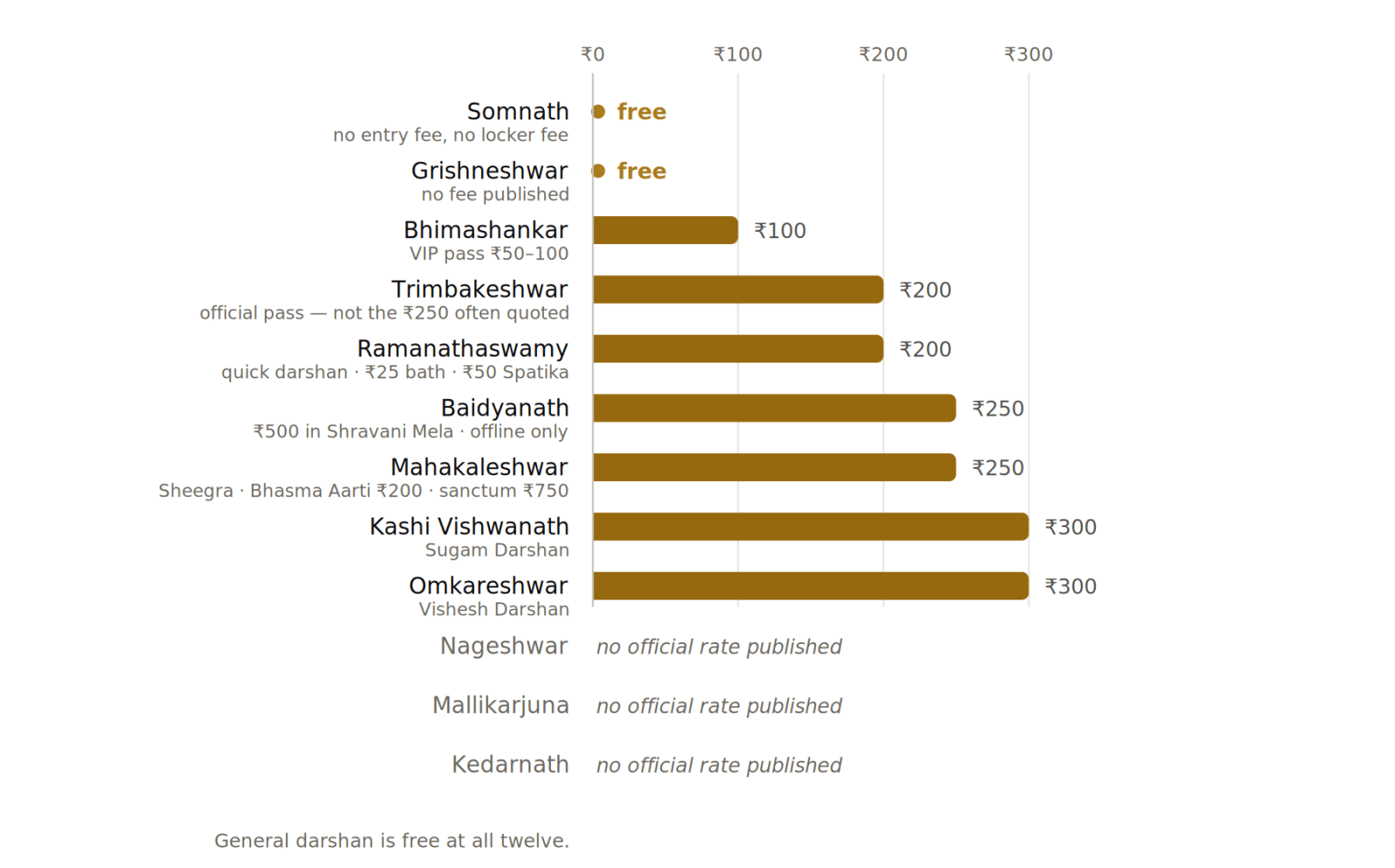
Official fast-track or special-darshan ticket, per person, where one exists. General darshan is free everywhere. Two temples publish no rate card I could verify.
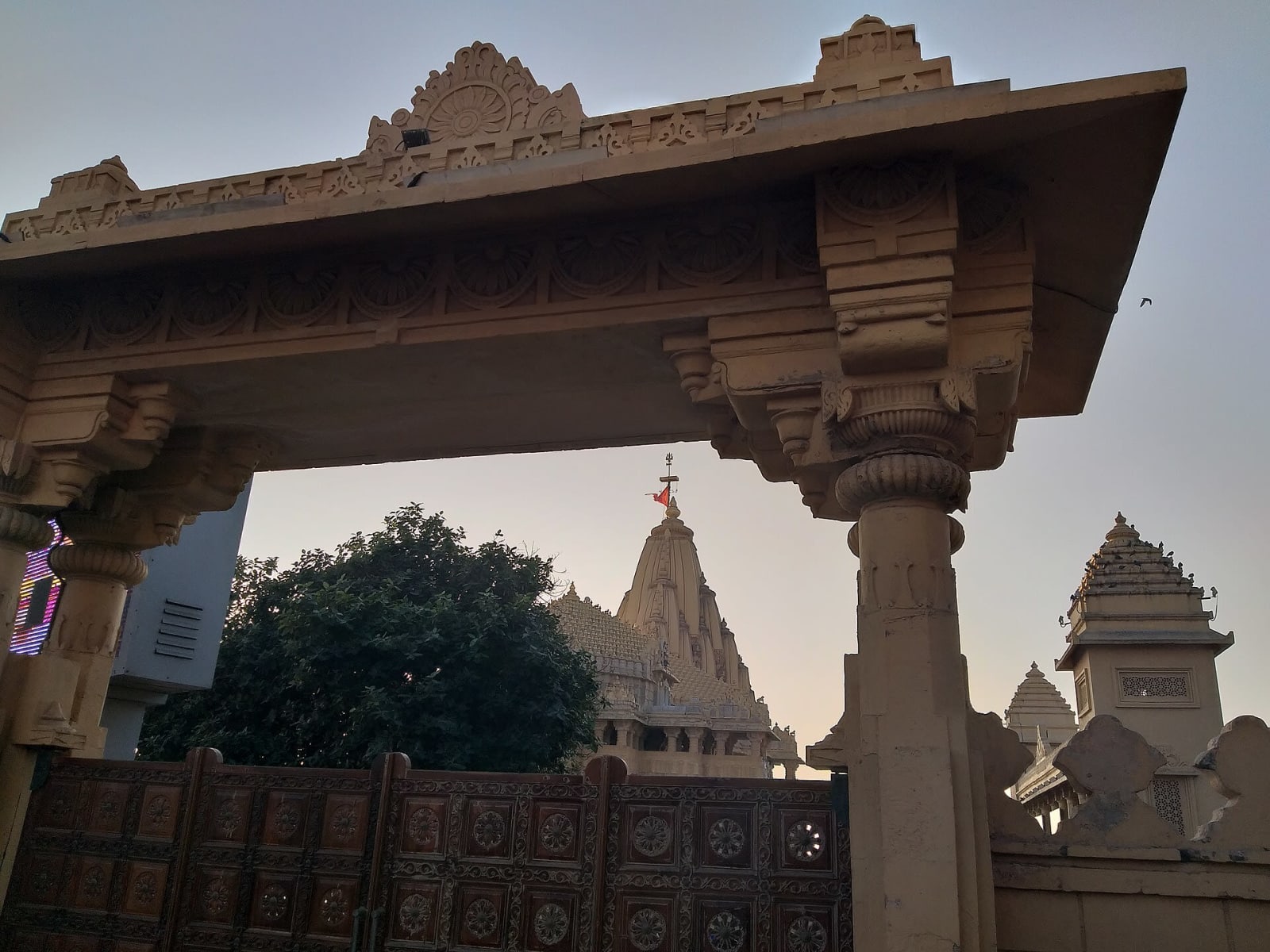
Somnath charges nothing — no entry fee, no locker charge. All electronics are prohibited inside, so the free lockers matter. Photo: VasuVR · CC BY-SA 4.0 · Wikimedia Commons
Free general darshan is available at every one of the twelve. What you see above is the optional fast-track ticket. And a few of these deserve comment.
Somnath charges nothing at all. The official FAQ is explicit: no admission fee, no locker charge. Free lockers, free shoe storage. All electronics are prohibited inside, so the lockers matter.
Kashi Vishwanath publishes a full rate card on its own booking portal — the best-documented pricing of the twelve, and worth reproducing in full because third-party sites reprint it badly:
| Service | ₹ |
|---|---|
| Sugam Darshan (queue-less) | 300 |
| Rudrabhishek (1 Shastri) | 450 |
| Rudrabhishek (1 Shastri), video conference | 700 |
| Rudrabhishek (5 Shastri), video conference | 2,100 |
| Mangla Aarti | 500 |
| Mid-day Bhog Aarti | 300 |
| Sapt Rishi Aarti | 300 |
| Shringaar / Bhog Aarti | 300 |
| Akhand Deep | 700 |
| Satyanarayan Katha | 500 |
| Sanyasi Bhojan (daily) | 3,000 |
| Sanyasi Bhojan (Monday) | 4,500 |
| Dainik Ratri Kalin Shringar (9 PM) | 5,000 |
| Purnima Shringaar | 3,700 |
One warning attached to that ₹300 Sugam Darshan: during Sawan, Kashi switches to Jhanki Darshan — viewing from a distance — on Mondays, and Sparsh Darshan is restricted. In Sawan 2024 the administration cancelled all daily passes on every Monday of the month. Sawan ke Somvar ke liye Sugam pass lena matlab paisa paani mein — woh cancel bhi ho sakta hai.
Trimbakeshwar's official pass is ₹200, not ₹250. ₹250 waala figure bahut saari third-party sites par hai, aur galat hai. Straight from the temple trust: ₹200 per person, non-transferable, valid the same day only, last entry 21:00, refundable only within 30 minutes of the transaction, and free for four categories: children under 10, people over 65, Divyangjan with a UDID card, and pregnant women beyond six months.
Baidyanath's Shighra Darshanam is ₹250 on normal days and ₹500 during Shravani Mela and Shivaratri — and it is offline only, bought at the temple administration office, counter open 06:00 to 18:00. Koi aapko online Baidyanath fast-track ticket bech raha hai, toh woh official nahi hai — itna samajh lijiye. And here is the detail that actually catches people out: during Shravani Mela the counter is closed on Sundays and Mondays because of the crowds — precisely the days a mela pilgrim would go looking for it.
Rameswaram charges in small pieces: ₹25 for the 22-theertham bath, ₹50 for Spatika Lingam darshan (you need to be there by 4 AM), ₹100 for special darshan, ₹200 for quick darshan. Kuch sau rupaye rakh lijiye aur ek waterproof pouch zaroor — bais baar bheegna hai. (These four figures are widely and consistently reported, but I could not find them on an official HR&CE rate card, so hold them at the same confidence level as the Mahakal numbers below.)
Two gaps I could not close honestly. I found no verifiable published arjitha-seva rate card for Mallikarjuna at Srisailam, and no verifiable special-darshan tariff for Kedarnath. Rather than reprint an unsourced number, I have left both as "not published." If you have official documentation for either, I would like to see it.
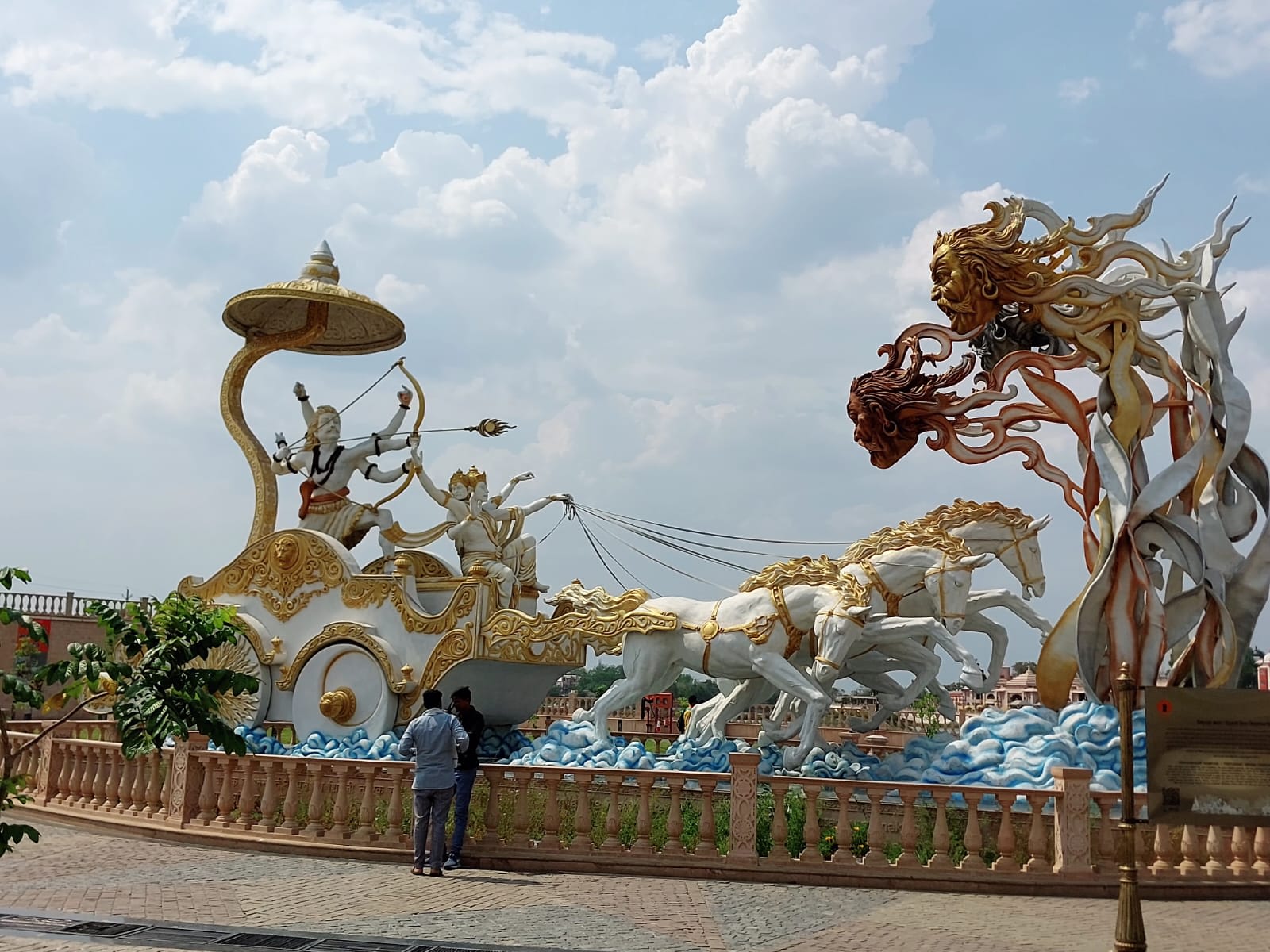
Mahakaleshwar, Ujjain. Photo: Nilimajhapate · CC BY-SA 4.0 · Wikimedia Commons
The Bhasma Aarti arithmetic
Mahakaleshwar ko alag paragraph isliye mil raha hai kyunki sabse chhoti cheez par sabse zyada paisa yahin barbaad hota hai.
The official cost of a Bhasma Aarti permit:
- ₹200 per person booked online
- ₹100 per person booked at the counter the previous day
- ₹0 in the general queue
Agents outside Ujjain routinely quote ₹2,000 to ₹5,000 for "guaranteed" Bhasma Aarti tickets. That is between ten and twenty-five times the official online price — and up to fifty times the counter price. The guarantee, needless to say, is not theirs to give.
While we are here — Mahakal's other official charges are ₹250 for Sheegra Darshan and ₹750 (single) or ₹1,500 (couple) for Garbh Grah entry, with the sanctum generally closed to the public on Sawan Mondays, Nag Panchami and Mahashivratri. Note for 2026 planners: in August 2026 that list covers four Mondays — 3, 10, 17 and 24 August — and 17 August is simultaneously Nag Panchami and a Shravan Somvar in both the North Indian and the Maharashtrian calendars. Us din sanctum ticket ki ummeed mat rakhiye, aur bheed apni zindagi ki sabse zyada dekhoge.
(A fuller piece on how Bhasma Aarti booking actually works is coming separately — this is just the money.)
Trimbakeshwar pujas: where the real spending happens
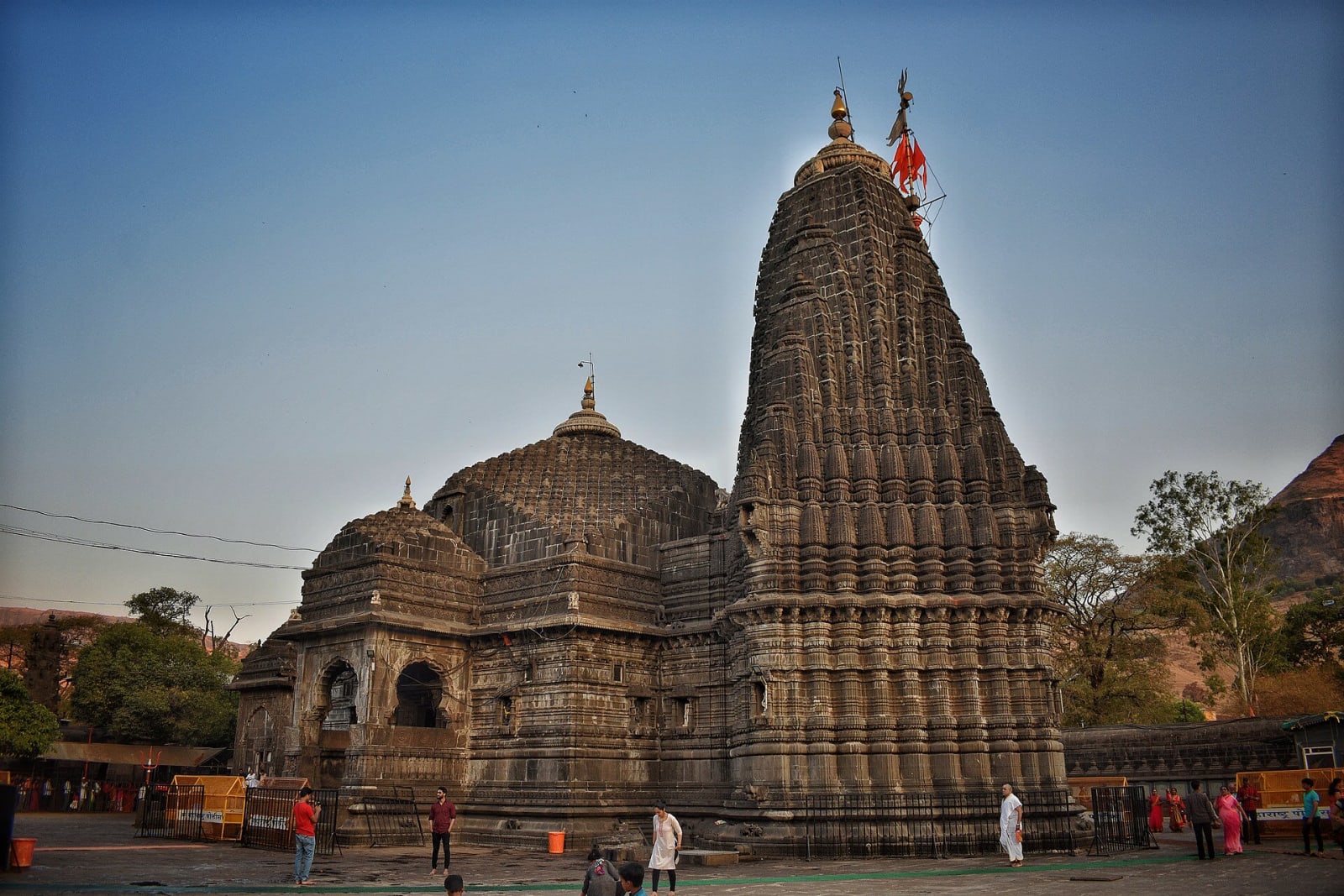
Trimbakeshwar. The darshan pass costs ₹200. The pujas people come here for range from ₹1,100 to ₹1,30,000. Photo: Abhideo21 · CC BY-SA 4.0 · Wikimedia Commons
If you are going to Trimbakeshwar for Kaal Sarp Dosh nivaran or Narayan Nagbali rather than just for darshan, the puja will cost you many times what the entire rest of your yatra's temple tickets cost combined.
These are pandit fees, not temple tariffs — negotiated rates from the priest networks around the temple, and they vary. Indicative published figures:
| Puja | ₹ |
|---|---|
| Kaal Sarp Dosh (group) | 1,100 per person |
| Kaal Sarp Dosh (in temple) | 2,100 – 2,500 |
| Kaal Sarp + Rahu Ketu jaap | 5,100 |
| Tripindi Shradha | 2,251 – 3,001 |
| Pitra Dosh Nivaran | 5,500 |
| Narayan Bali | 7,000 – 8,000 |
| Narayan Nagbali (3-day rite) | 4,100 / 5,100 / 6,100 by tier |
| Rudrabhishek | ~2,000+ |
| Mahamrityunjay Jaap (9 days) | 1,30,000 |
One caution on that table: the published figures for Narayan Nagbali do not reconcile cleanly across sources — the three amounts are variously presented as per-day charges and as service tiers, and the totals quoted do not match the parts. Get a single written total before you commit.
Do baatein pahunchne se pehle jaan lijiye.
Narayan Nagbali is a three-day rite. Ek subah ka kaam nahi. Teen din. A very large number of people book travel that assumes it is a single-session puja and then have to change their tickets.
Page one of Google for these pujas is eight near-identical booking domains. There is essentially no neutral information, which is exactly why the quoted prices are all over the place. Quote likhit mein lijiye, sankalp mein kya-kya shaamil hai woh confirm kijiye, aur din kitne lagenge yeh bhi — paisa dene se pehle.
Kedarnath: the leg that breaks every budget
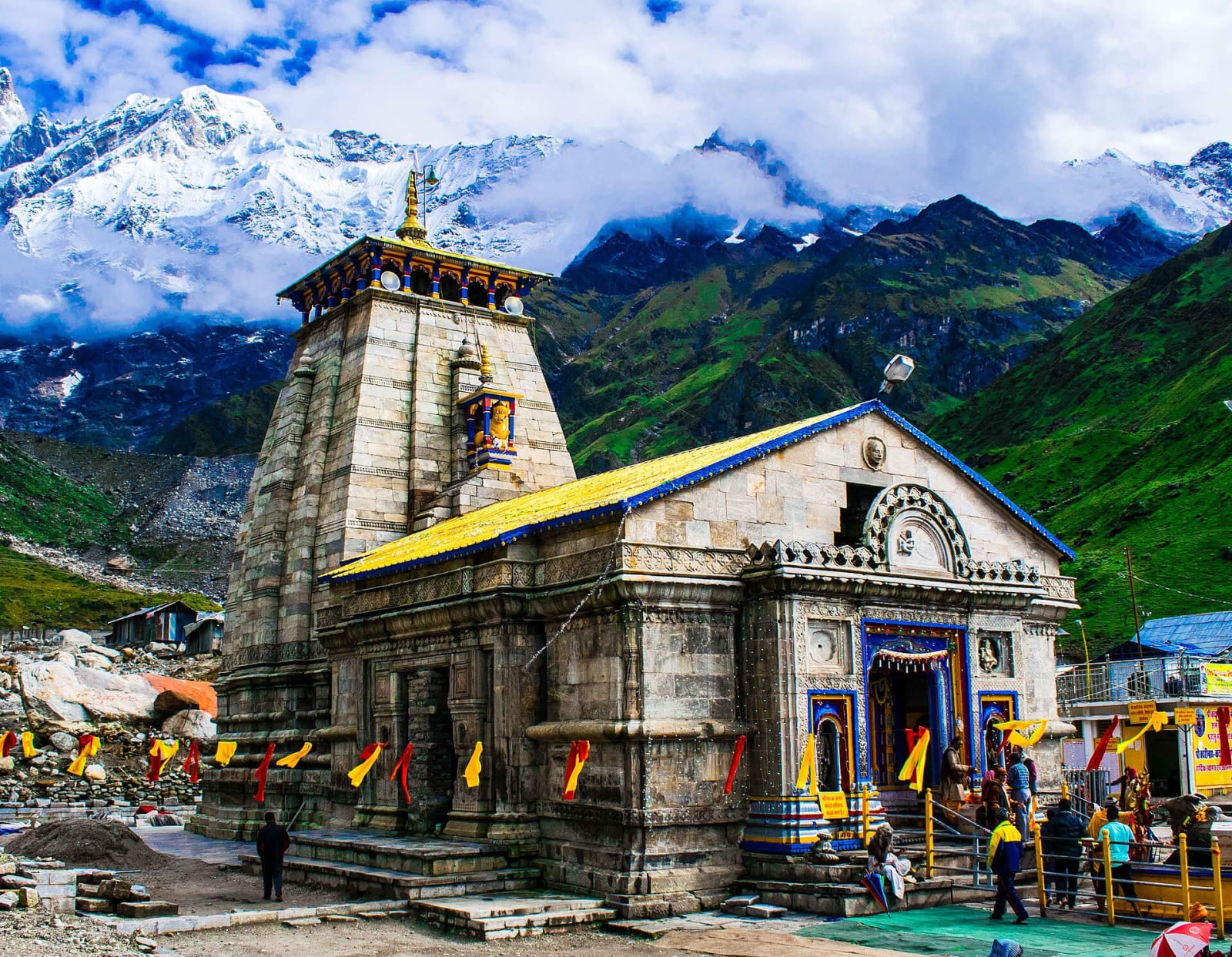
Sixteen kilometres on foot, each way — or a regulated helicopter fare that is revised every season. Photo: Shivam Kumar 766 · CC BY-SA 4.0 · Wikimedia Commons
Har baarah-shrine budget mein ek line item aisa hota hai jo baaki sab se alag behave karta hai.
Kedarnath is 16 km on foot from Gaurikund, each way. Six to nine hours up if you are fit. Or a helicopter, and the helicopter fares are regulated by UCADA and revised annually. The 2025 revision:
| Sector | 2025 | 2026 (two sources) |
|---|---|---|
| Sersi ↔ Kedarnath | ₹8,900 | ₹6,086 – 6,390 |
| Phata ↔ Kedarnath | ₹8,500 | ₹9,680 – 10,164 |
| Guptkashi ↔ Kedarnath | ₹12,444 | ₹12,154 – 12,762 |
Note what happened between those two columns: the ordering flipped. In 2025, Sirsi and Phata were within ₹400 of each other. For 2026, Sersi is roughly ₹3,500 cheaper than Phata. If you are working off an article written last season — and most of the ones you will find are — you will book the wrong sector.
Honest flags. The two 2026 sources disagree with each other by 5–8%, so treat the right-hand column as a range and not a price. Both describe the fares as round-trip base fares, with GST and the IRCTC convenience fee extra. The 2025 coverage was itself inconsistent about round-trip versus one-way and described the same revision as both a 31–40% and a 49% increase. Fares are UCADA-regulated and re-set every season — check heliyatra.irctc.co.in rather than relying on any article, including this one.
Three more Kedarnath costs that don't appear in package quotes: pony or palanquin if you are not walking it, accommodation at Gaurikund or Sonprayag on either side of the trek, and — the one that actually bites — weather-delay nights. Helicopter services are grounded routinely. Mausam ka koi bharosa nahi — ek extra din aur uska paisa, dono rakh kar chaliye.
The registration itself is free. It is also mandatory for Kedarnath, Badrinath, Gangotri, Yamunotri and Hemkund Sahib, done at registrationandtouristcare.uk.gov.in or via WhatsApp on +91-8394833833. And despite being universally described as "biometric registration," the 2026 system is QR-based — a code scanned at the shrine, no fingerprints taken. Over 50 lakh registrations had been issued by 15 June 2026.
Doing it yourself: the real numbers
Seedhi baat pehle: koi bhi verifiable source is yatra ka credible per-day self-planned budget publish nahi karta. Jo aapko exact daily figure bata raha hai, usne bana liya hai. What I can do is derive a range from published whole-trip tiers, and label it as derived.
Taking a well-known operator's own three tiers over their own recommended 18–24 day duration:
| Tier | Whole trip | Implied per day (over 21 days) |
|---|---|---|
| Budget | ₹30,000 – 50,000 | ₹1,400 – 2,400 |
| Standard | ₹55,000 – 90,000 | ₹2,600 – 4,300 |
| Premium | ₹95,000 – 1,60,000+ | ₹4,500 – 7,600 |
And here is roughly where the money goes in each tier:

Indicative composition of a 21-day self-planned yatra at three spending levels. Derived from published tier totals, not from a surveyed sample — treat the shape as more reliable than the individual segments.
The shape of that chart is the real finding: transport dominates at every level, and darshan tickets are almost invisible. Log mandir ki fees ki chinta karte hue trip plan karte hain, aur phir Dwarka-se-Ujjain waale 833 km unki band baja dete hain.
The 8,230 km problem
Here is the number that actually determines your budget. Done as a surface circuit, the full twelve comes to approximately 8,230 road kilometres, plus a 32 km round trip on foot at Kedarnath — before any local sightseeing.
The legs that hurt:
| Leg | Road km | Realistic time |
|---|---|---|
| Dwarka → Ujjain | 833 | 15–17 hrs |
| Rameswaram → Varanasi | 2,361 | 40 hrs+ |
| Deoghar → Gaurikund | 1,485 | 30 hrs+ |
| Srisailam → Rameswaram | 946 | 17–19 hrs |
| Grishneshwar → Srisailam | 766 | 14–15 hrs |
Sirf yeh paanch legs 6,391 km ke hain. Isi liye har serious baarah-shrine itinerary inmein se kam se kam do legs flight ya train se karti hai — aur isi liye "₹10,500 mein 12 Jyotirlinga" arithmetically namumkin hai.
The cheap clusters, by contrast, are genuinely cheap: Ujjain to Omkareshwar is 134 km, and Trimbakeshwar to Bhimashankar is 238 km by road (they are only 96 km apart as the crow flies — the Sahyadris are in the way).
What is not in the quote
Jitne operators maine dekhe, unmein yeh cheezein sabse zyada baar exclude hoti hain — aur yahi baad mein surprise bankar aati hain:
- VIP and special darshan passes at every temple. Almost universally excluded.
- Personal pujas, abhishek and sankalp — including the Trimbakeshwar rites above.
- Kedarnath pony, palanquin and porter charges.
- Helicopter fares, unless the package explicitly says "heli-inclusive."
- Travel insurance, on the cheaper tiers.
- Weather-delay accommodation — the Kedarnath one, and the Rameswaram-cyclone-season one.
- Laddu prasad and offerings, which add up faster than people expect across twelve temples.
- Tips and guide charges, particularly at Rameswaram where the 22-theertham circuit is effectively guided.
One operator recommends holding a 10–15% contingency above the package price, rising in festival windows. Upar ke numbers dekhte hue, yeh sales line nahi — sahi salaah hai.
A worked example
For someone doing it themselves, 18 days, all twelve, sleeper class and 3AC where needed, one flight for the Rameswaram–Varanasi leg, dharamshalas and budget hotels, Kedarnath on foot:
| Line | ₹ |
|---|---|
| Long-distance rail (sleeper/3AC mix) | 9,000 |
| One flight, Madurai → Varanasi | 6,500 |
| Local taxis, autos, shared jeeps | 8,500 |
| Accommodation, 17 nights | 12,000 |
| Food, 18 days | 5,500 |
| Special darshan tickets, all twelve | 1,800 |
| Offerings, prasad, lockers, sundries | 2,500 |
| Contingency at 12% | 5,500 |
| Total | ≈ 51,300 |
That lands at the top of the "budget" tier and the bottom of "standard," which is about right for a trip that includes Kedarnath on foot and one flight. Add a helicopter and you are at ₹60,000. Add private cabs throughout and you are at ₹85,000. Book the same thing as a private package and you are at ₹1,00,000.
Yeh estimate hai, quotation nahi. Prices move, fuel moves, and the Kedarnath window is weather-dependent. Use the structure, not the total.
What pilgrims ask
What is the cheapest realistic way to do all twelve?
Sleeper class, dharamshalas, general darshan queues everywhere, Kedarnath paidal, and one flight for the Rameswaram–Varanasi leg — around ₹30,000–35,000 per person over about three weeks, agar aap halka travel kar rahe hain aur time hai. Isse kam mein kuch na kuch itinerary se nikala ja raha hai.
Is the IRCTC package good value?
On the ordinary Bharat Gaurav train, ₹17,600 in sleeper for seven shrines with meals, hotels and transfers handled is very good value. On the Deluxe AC train at ₹88,810 and up, you are paying twelve-shrine private-package money for seven shrines. Either way, be clear that it is seven, and plan the other five separately.
Do I have to pay for special darshan?
Bilkul nahi. General darshan is free at all twelve. Special darshan aapko line ka time bechta hai, access nahi — aur Kashi mein Sawan ke Somvar ko toh woh bhi nahi.
How much should I budget for pujas?
Nothing, unless you specifically want one. If you are going for Kaal Sarp Dosh or Narayan Nagbali at Trimbakeshwar, budget ₹2,000–8,000 depending on the rite, get the quote in writing, and confirm the number of days.
Can I do it in one trip, or should I split it?
Financially, splitting into three regional trips — Gujarat, the Maharashtra five plus MP, and then the North and South outliers — usually costs more in total but is far easier to fund and to take leave for. Jo log saare baarah poore karte hain, woh zyadatar saalon mein karte hain, hafton mein nahi.
Is Kedarnath worth the helicopter?
If you have a knee problem, altitude sensitivity, or you are travelling with elderly parents, yes. Otherwise the walk is part of it. Just budget the spare day either way — the grounding risk is real.
When is it cheapest to go?
Sawan (30 July – 28 August 2026 in the North; 13 August – 11 September in Maharashtra and the South) aur Mahashivratri se bachiye. Mandir ke aas-paas kamre ke daam kai guna ho jaate hain aur har line teen guna lambi. Uske aage-peeche ke mahine kaafi saste padte hain.
Are online darshan-booking sites legitimate?
Some are. Many are intermediaries charging a large markup on a cheap or free official ticket, and a few are selling things that cannot be sold — Baidyanath's Shighra Darshanam, for instance, is offline-only. Book through the temple trust's own portal wherever one exists.
Sources and how much to trust them
Strong — straight from the temple: Kashi Vishwanath's rate card (shrikashivishwanath.org booking portal); Trimbakeshwar's ₹200 pass (trimbakeshwartrust.com); Somnath's no-fee policy (somnath.org FAQ); Char Dham registration (registrationandtouristcare.uk.gov.in).
Reasonable — published operator pricing, verified against the operators' own live listings: Tourism of India, Kanaiya Travels, Tour Times, TrekGo and Su Yatra. Su Yatra's ₹10,500 turns out to be a 2N/3D Dwarka–Somnath package covering two Jyotirlingas — which is exactly why it sits at the bottom of the chart with a caveat rather than in the same comparison as an 18-day itinerary.
Weaker — single-sourced or second-hand, flagged in the text where used: both IRCTC fare tables (the portal renders client-side, so the figures come from press coverage and a secondary source); Mahakaleshwar's Sheegra and Garbh Grah pricing (the official Ujjain temple site blocks automated retrieval, so every Mahakal figure here is third-party); the Rameswaram ticket prices; the Trimbakeshwar puja rates, which are pandit fees rather than published tariffs; Bhimashankar and Omkareshwar VIP pricing.
Disputed — do not treat as settled: the Kedarnath helicopter fares. The two 2026 sources differ by 5–8%, and the 2025 coverage was inconsistent on round-trip versus one-way and on the size of the increase.
Derived, not sourced: the per-day budget figures and the budget-composition chart, both computed from published whole-trip tiers.
Not found: any verified rate card for Mallikarjuna at Srisailam; any verified special-darshan tariff for Kedarnath; any credible published per-day self-planned budget.
Road distances were computed with the OSRM routing engine on OpenStreetMap data rather than copied from aggregator sites, because the aggregators disagree substantially — Ujjain to Omkareshwar is variously published as 110, 134 and 140 km. Driving times shown as "realistic" add 25–40% to the raw routing estimate, which is what Indian road conditions actually require.
Last verified: 20 August 2026. Every price on this page will drift. Confirm anything you are about to pay for against the temple's own portal before you travel — and if you find something here that is out of date, please tell us.