General darshan
Free and unticketed. On ordinary weekdays the queue is short; Shravan Mondays are a different matter entirely.
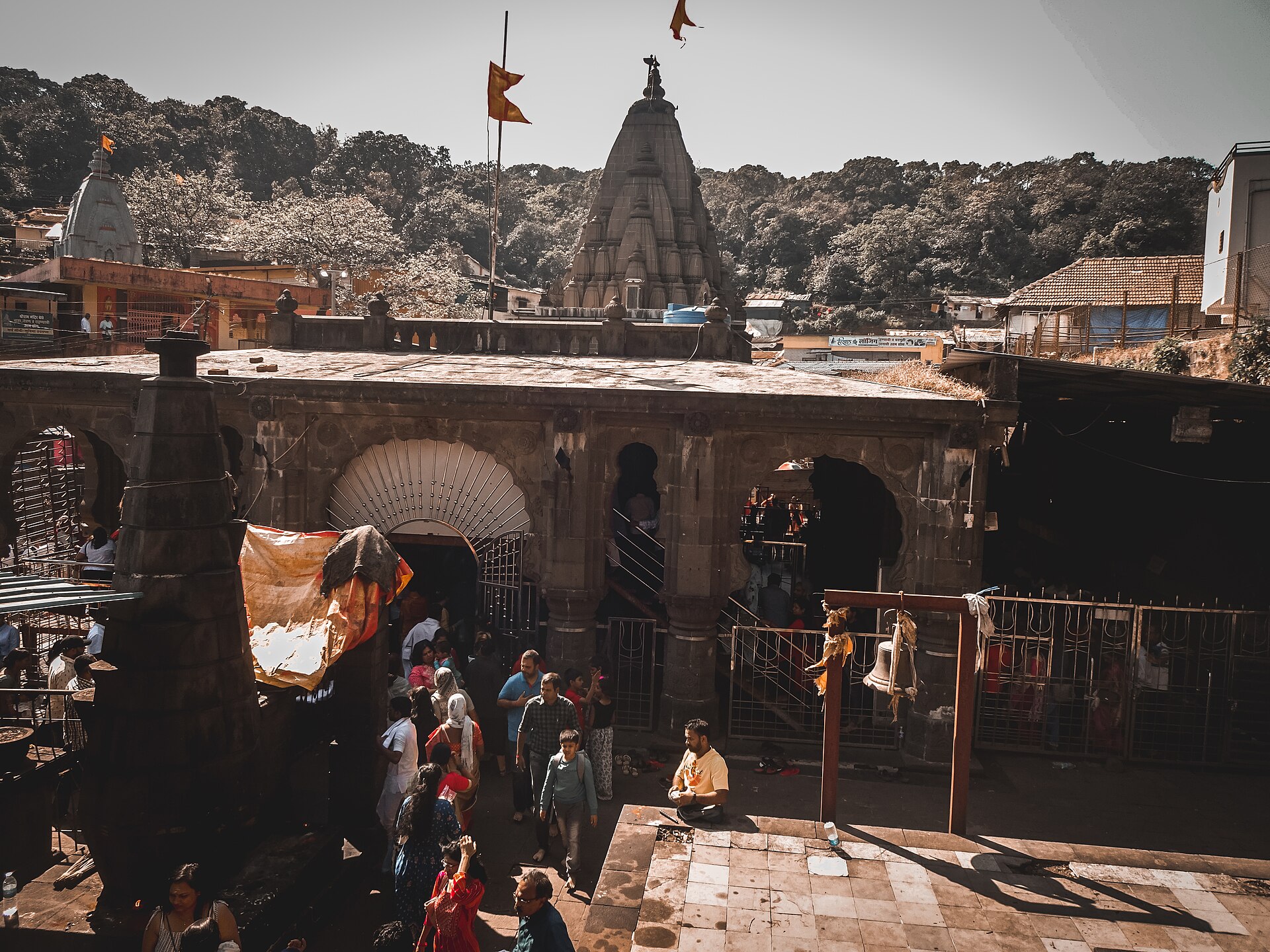
Deep in the Sahyadri, inside a wildlife sanctuary that shelters the Indian giant squirrel, the sixth jyotirlinga sits where the Bhima river begins. It is the only one of the twelve you reach through a forest.
A demon born of Kumbhakarna.A battle fought at dawn.A river made of what it cost.
Why Shiva is here, and not somewhere else — as the Shiva Purana and local tradition tell it.
Bhima, born to Kumbhakarna's widow Karkati, grew up in the Sahyadri not knowing his father had been killed by Rama's side. When his mother told him, he set out to make the gods pay for it.
Bhima conquered the world and imprisoned the devotee-king Kamarupeshwar for worshipping Shiva. In his cell the king made a lingam of earth and worshipped anyway. Bhima raised his sword to smash it.
Shiva emerged from the lingam and the fight that followed shook the hills. The demon was reduced to ash. The gods asked Shiva to remain on the ridge, and he did — and the sweat of that battle, running off his body, became the Bhima river, which still rises here and flows all the way to the Krishna.
Times shown in IST. The status above is live against the temple's published hours.
The temple opens at 4:30 AM with Kakad Aarti and closes around 9:30 PM. A short Naivedya break falls around noon. Timings occasionally tighten during renovation work — confirm at bhimashankar.in before a long drive.
What can be booked, what is free, and where the official channel actually is.
Free and unticketed. On ordinary weekdays the queue is short; Shravan Mondays are a different matter entirely.
A paid quick-darshan pass is available at the counter on busy days. There is no large online booking system here.
bhimashankar.in ↗Panchamrit abhishek and sponsored puja are arranged at the temple office in the early morning; ask on arrival.
Modest clothing. Traditional dress is preferred for abhishek in the sanctum.
Saree, salwar-kameez or anything covering shoulders and knees.
Khed, Sahyadri Hills, Maharashtra — 19.0722°N, 73.5361°E
Nearest airport, three to four hours by taxi through the ghats. Mumbai is ~220 km.
The practical railhead, with connections from Mumbai, Delhi, Hyderabad and Bengaluru. Karjat is nearer as the crow flies but the road is worse.
MSRTC buses from Pune Shivajinagar (3.5 hrs). Taxi from Pune runs ₹2,500–₹3,500 one way. From Mumbai it is roughly five hours via Karjat.
November to February is the most comfortable. The monsoon (Aug–Sep) turns the Sahyadri spectacularly green and is the best time for the sanctuary — but the road is slippery and the mist can be total. Avoid April–May heat.
Dense Sahyadri forest, the last stronghold of the Indian giant squirrel.
A quiet forest pool a short walk from the temple; good chance of spotting the Shekru.
The hidden origin point of the Bhima, in a fold of the forest.
The Cobra Hood — a cliff edge with a vast drop into the Konkan.
Freely-licensed photographs from Wikimedia Commons. Each is credited to its photographer.


Pilgrimage vlogs from independent travellers on YouTube — the walk in, the queue, the darshan. Nothing loads until you press play.
Light a lamp for Bhimashankar and it stays lit across the site — your progress towards all twelve is remembered on this device.