How Many Days Does the Full 12 Jyotirlinga Yatra Take?
The honest floor is 15 days with flights and a helicopter. The comfortable standard is 18 to 21. By train it is 24. But before any of that comes a question nobody asks: what month are you going? Because for six months of the year, the twelve-shrine yatra is an eleven-shrine yatra.

Kedarnath, the one shrine that decides how long, and in which month, the whole yatra can happen. Photo: Shivam Kumar 766 · CC BY-SA 4.0 · Wikimedia Commons

Contents
- The short answer
- The gate: Kedarnath's six-month closure
- The window where all twelve are actually possible
- So how many days? The real spread
- What each duration actually buys you
- Where the days actually go
- Time per shrine: the honest numbers
- The sane alternative: do it in clusters
- Red flags in a short package
- What pilgrims ask
- Related reading
- Sources and confidence
Search this question and you will get numbers thrown at you with great confidence. Twelve days. Fifteen. Eighteen. One operator sells a "compressed" twelve-day package. Another says twenty-five to thirty for comfort.
Every one of them skips the question that actually decides the answer.
What month are you going?
Because Kedarnath, one of the twelve, is shut for roughly six months a year. Not crowded. Not difficult. Shut. The temple closes, the 16 km trek from Gaurikund closes, Gaurikund's tourist infrastructure shuts down, and the road above Sonprayag becomes unreliable. Aur dikkat yeh hai: the months Kedarnath is closed are exactly the months that are pleasantest for the other eleven. The calendar works against you.
So the days question comes second. Pehle mahina.
The short answer
If you are travelling between roughly mid-November and late April, the full twelve-shrine yatra is not available at any number of days. You will do eleven and visit Kedarnath's winter seat at Ukhimath instead. That is a real darshan and an old one. The deity really is there. It is still not Kedarnath.
If you are travelling in the open window, these are the honest numbers:
- 15 days. The real floor. Requires six or seven domestic flights and a helicopter at Kedarnath. No slack for weather.
- 18 to 21 days. The standard. This is where nearly every serious operator lands, and where the trip stops feeling like an endurance event.
- 24 days. What it costs if you go by train instead of flying. Cheaper in rupees, more expensive in time.
- 25 to 30 days. If you actually want to be at these places rather than tick them off.
One number to sit with before you book anything. A 19-day trip runs to roughly 456 hours. You will spend about 36 hours of it in darshan. Eight percent. Yeh sunne mein ajeeb lagta hai, par hisaab yahi hai.
The gate: Kedarnath's six-month closure
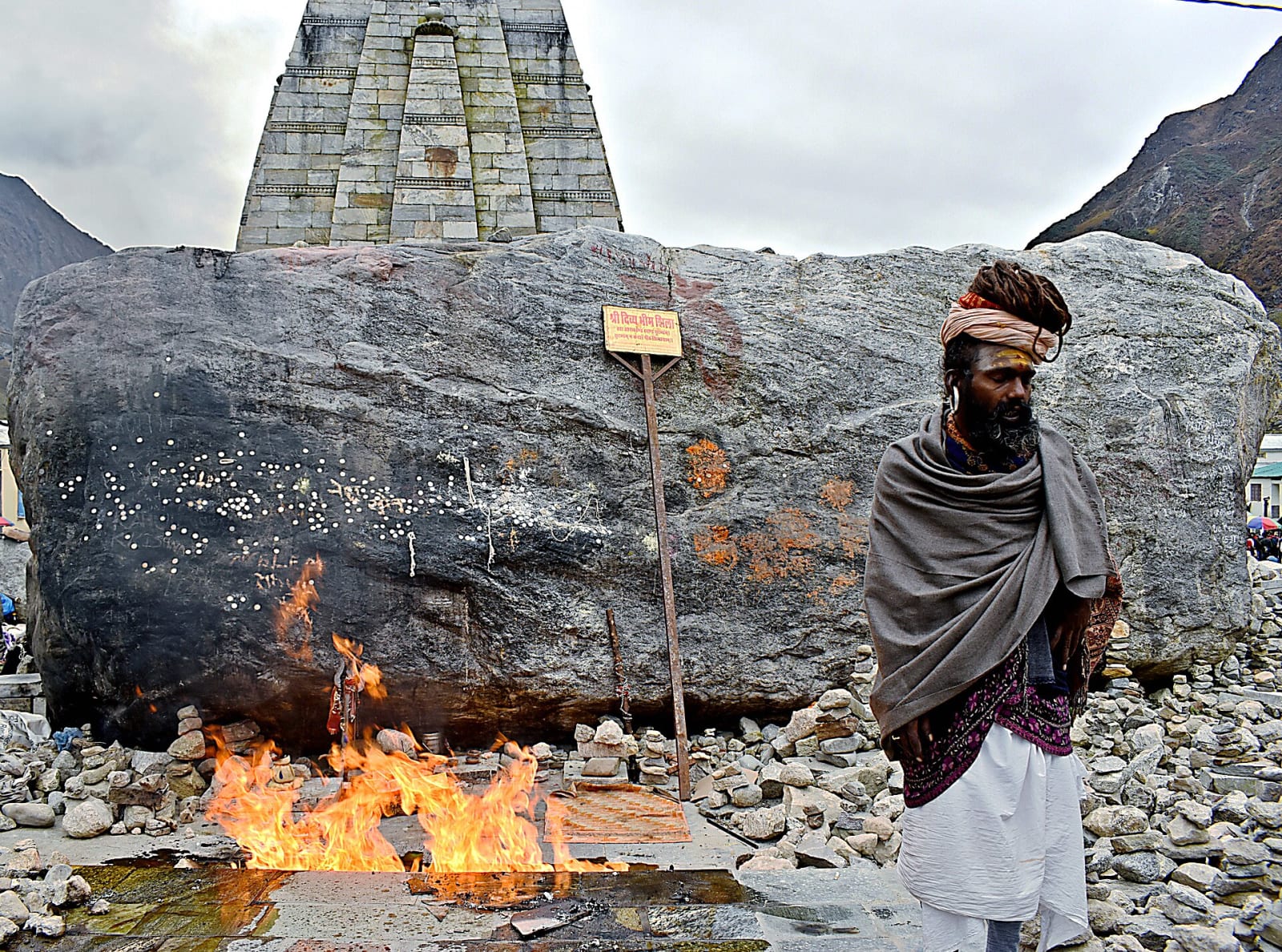
Kedarnath at 3,583 m. Open 22 April to about 11 November in 2026, and physically shut the rest of the year. Photo: Rohit Sharma · CC BY-SA 4.0 · Wikimedia Commons

For 2026 the dates are:
| Portals | Date | Confidence |
|---|---|---|
| Opened | 22 April 2026, 8:00 AM | Confirmed; announced on Mahashivratri |
| Closes | ~11 November 2026 (Bhai Dooj) | Expected, formally confirmed on Vijayadashami |
Please do not take "early November" as a rule. The closing follows Bhai Dooj, and Bhai Dooj moves. 2025: 23 October. 2024: 3 November. 2026: 11 November. That is a three-week swing. If your itinerary lands in late October, check that year's date yourself. Kisi article par mat jaiye, including this one.
What "closed" actually means, in the words of the people who run the route: snow depth above three metres on the trek, temperatures below −10°C, Gaurikund base camp shut with no operational accommodation, the Sonprayag–Gaurikund road typically impassable from late November, and helicopters offering "distant views only," with no landing near the closed temple. Sonprayag and Gaurikund are inhabited villages and you may be able to reach the lower stretches in good weather, but there is no darshan and effectively no services.
What operators actually do about it
This never makes the sales page, so the operators who do say it out loud deserve quoting.
Memorable India, on their 18-day Delhi package: any trip running in "December, January or February substitutes Kedarnath with a symbolic darshan at Ukhimath," and "if the plan excludes Kedarnath for a winter departure, duration compresses to 14 nights and one flight sector to Dehradun drops out."
That last bit is the whole problem in one line. Three nights come off the trip. Those three nights were Kedarnath. Take it out and the yatra is simply shorter, which is about as clear an admission as you will get that a winter "12 Jyotirlinga tour" is not doing twelve.
Kanaiya Travels handles it differently: helicopter Kedarnath when the temple is open (they say May to October), and off-season they swap the whole Uttarakhand leg for a longer Vaidyanath–Kashi extension. Swantour more or less concedes defeat and recommends October to April "keeping Kedarnath for May onwards." In other words, their recommended plan is two separate trips.
The winter seat at Ukhimath, properly explained
When the portals close on Bhai Dooj, the Panchmukhi Utsav doli, the five-faced processional idol, leaves Kedarnath and travels down over the following days through Rampur and Guptkashi to the Omkareshwar Temple at Ukhimath in Rudraprayag district. Worship continues there uninterrupted, following the same procedures as the summer rites, until the idol is carried back up for the spring reopening around Akshaya Tritiya.
In practice the two are not remotely alike:
| Compared | Kedarnath, in season | Ukhimath, in winter |
|---|---|---|
| Altitude | 3,583 m | ~1,300 m |
| From Rishikesh railhead | ~210 km road, then 16 km trek | 175 km road |
| From temple parking | 16 km on foot, 6–8 hrs | 2 km from the taxi stand |
| Time needed | 2 full days minimum, 3 comfortably | About an hour |
| Access | Weather-dependent, registration capped | "Fully accessible with reliable road access" |
So the winter substitute is a day's drive and an hour's visit, against a three-to-four-day round trip with a trek. Agar aap sardiyon mein ja rahe hain, toh yeh bura sauda nahi hai. Bas iska naam Kedarnath mat rakhiye.
And in season, it is still not guaranteed
And open does not mean safe. Just in 2026:
- 1 June. Yatra suspended entirely, IMD red alert for Rudraprayag and Chamoli, pilgrims told to postpone at least two days
- 12 May. Major congestion at Sonprayag stranded thousands
- July 2025, for precedent. A landslide at the Munkatiya sliding zone blocked the road and suspended the yatra
- 15 September 2026. A formal "second phase" of the season began as the monsoon eased
Keep a spare day in hand for the Kedarnath leg. Not a luxury, a requirement. Mausam kisi ka nahi sunta.
The window where all twelve are actually possible
Three separate things have to line up, and they only just manage it.
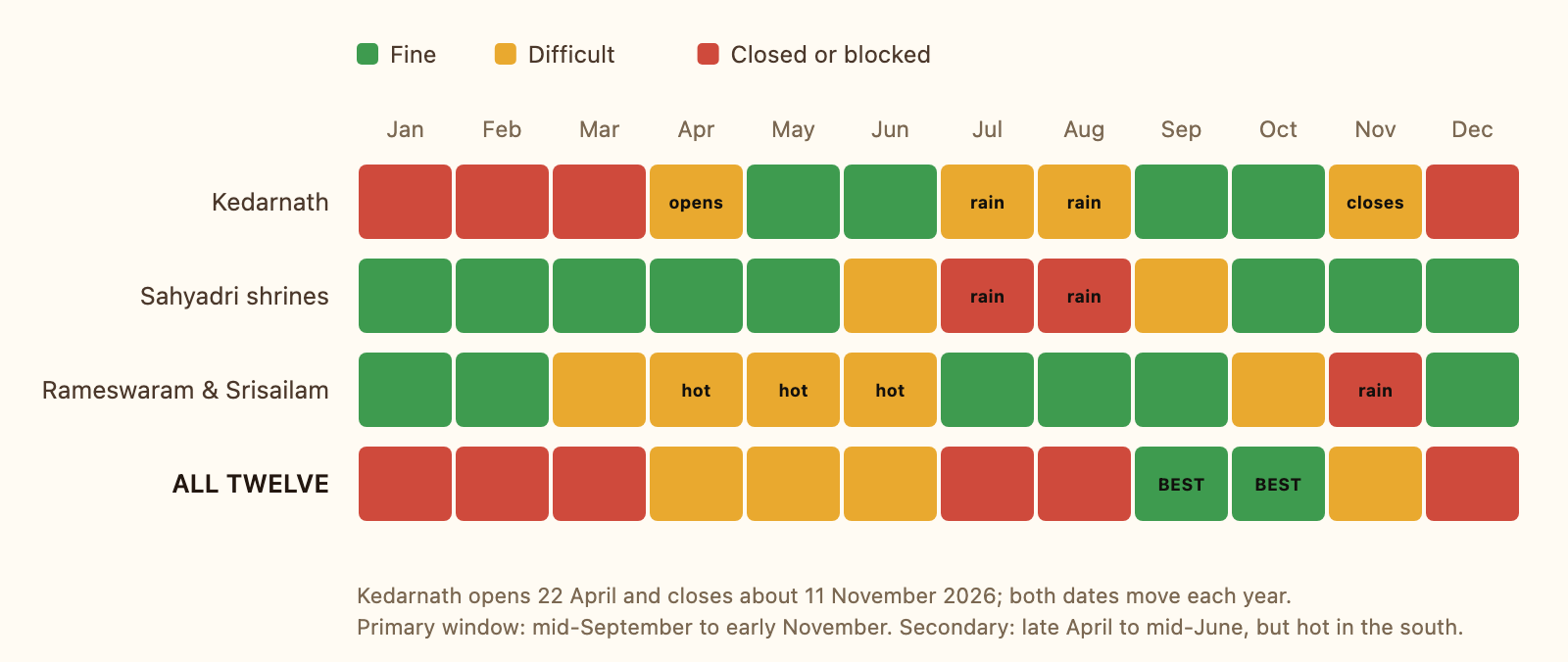
The three constraints that decide your travel month. The green band is the only comfortable overlap.
Constraint one: Kedarnath. Open 22 April to ~11 November, but with monsoon suspensions from late June to early September.
Constraint two: the Sahyadris. Bhimashankar, Trimbakeshwar and Grishneshwar sit in the Western Ghats monsoon. This is not a comfort issue. In July 2026 both approach roads to Bhimashankar, the Manchar route and the Rajgurunagar route, were blocked by landslides simultaneously, and authorities told pilgrims to postpone rather than attempt village alternates.
Constraint three: the South. Rameswaram and Srisailam are 27–40°C from March to June. Then the northeast monsoon arrives: Rameswaram gets roughly 8–14 rainy days in October and 10–16 in November, November being its wettest month at around 350 mm.
The answer: mid-September to the first week of November is the primary window. The Sahyadri monsoon has ended, Kedarnath is open and past its worst disruptions, Ujjain's Shravan crush is over, and the northeast monsoon has not yet peaked. A secondary window runs from late April to mid-June, but you will be doing Rameswaram at 38°C and Kedarnath at its most crowded.
If you are reading this when it was published, you are inside the primary window right now. Mid-September to early November 2026 is as good as this gets, and Kedarnath closes around 11 November.
And now the structural irony that most articles never notice: the months every operator recommends, October to March, are the months Kedarnath is shut for four of the six. That is why so many of them describe Kedarnath as a "separate extension" without ever explaining why.
So how many days? The real spread
Here is every genuine all-twelve package I could find, plotted by duration.
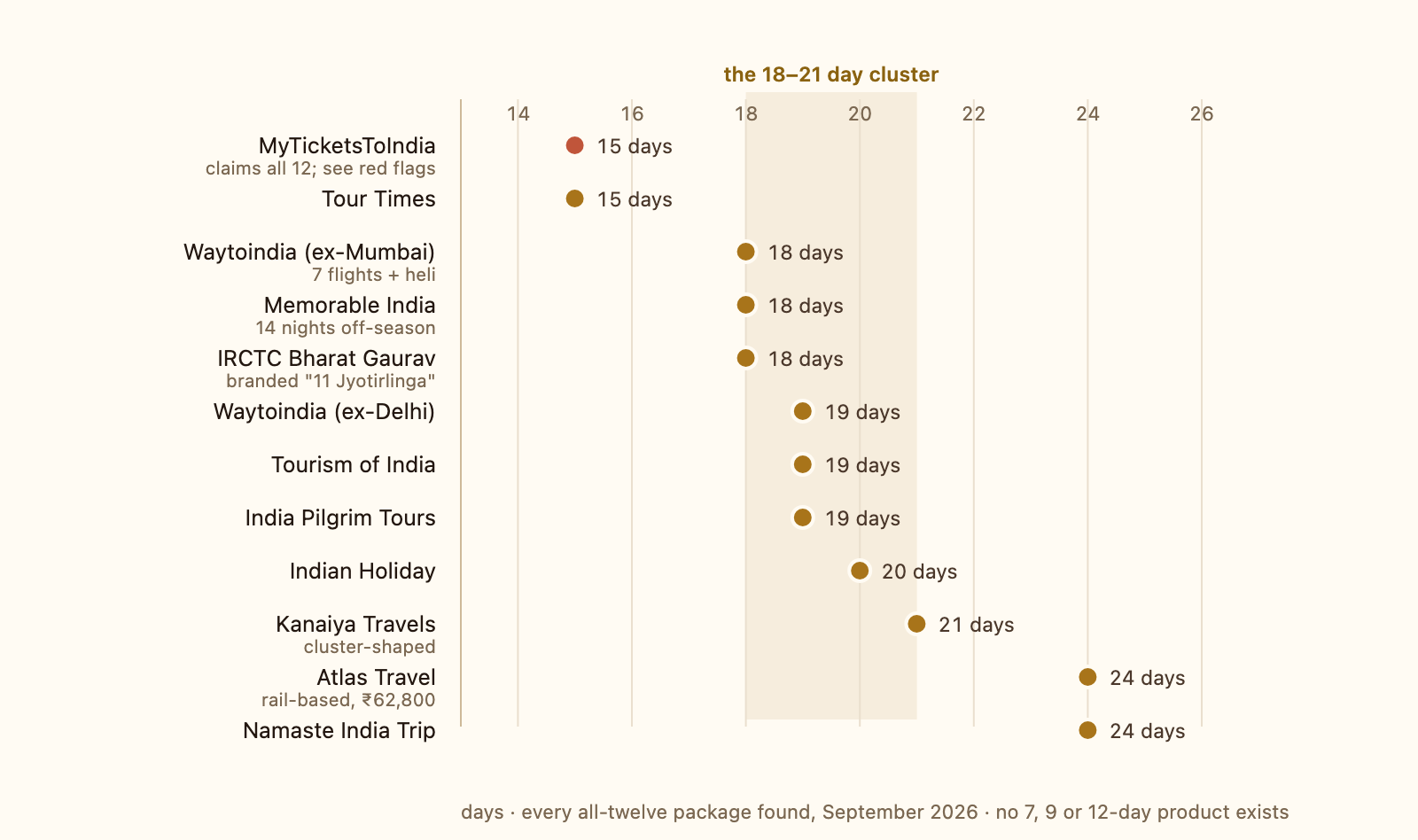
Real published all-twelve itineraries. There is no 7-day or 9-day product. I went looking. The shortest that actually exists is 15 days.
The clustering is obvious once you plot it: 18 to 21 days. Under 15 the itineraries stop making physical sense. Over 21 they start padding with Shirdi, Ajanta–Ellora and rest days.
A few of the published claims, and what I make of them:
| Claim | Who | Verdict |
|---|---|---|
| "18–25 days by train or road; 15–18 with flights" | Thomas Cook | The most credible published claim. It correctly makes the number a function of transport mode |
| Air 15–20 / Train 25–30 / Road 35–40 days | Holidaysathi | The most useful framework, and the assumption behind it (2–3 hours per temple) is a good sanity check |
| "A minimum of 20 days" | Shrine Yatra | Conservative and consistent with the operator cluster |
| "16–18 days" | Root Indians | Matches the modal product |
| "25–30 days for a comfortable trip" | Namaste India Trip | Credible as a comfort figure, not a minimum |
| "12 days, compressed" | TripCosmos | Marketing. No operator I found actually sells a 12-day all-twelve product |
What each duration actually buys you
This is the table I wanted when I started digging and could not find anywhere.
| You get | 15 days | 18–19 days | 21 days | 24 days |
|---|---|---|---|---|
| All twelve? | Yes, just | Yes | Yes | Yes |
| Transport | 6–7 flights, heli Kedarnath | 6–7 flights, heli Kedarnath | Flights + some rail | 6 overnight trains |
| Kedarnath | Helicopter only | Helicopter | Trek becomes optional | Pony or trek |
| Varanasi | 1 night | 2 nights | 2 nights | 2 nights |
| Ellora beside Grishneshwar | Skipped | Usually skipped | Included | Included |
| Omkareshwar parikrama | No time | Tight | Yes | Yes |
| Rameswaram 22 theerthams | Rushed | Yes | Yes | Yes |
| Bhasma Aarti at Ujjain | No | Possible | Yes | Yes |
| Buffer days for weather | Zero | Zero | One per region | Built in |
| Typical price | ₹1,05,000–1,48,450 | ₹1,01,128–1,19,000 | ₹78,999–84,999 | ₹62,800 |
Look at the bottom row for a second. The 24-day rail trip is the cheapest of the four, roughly half what the 15-day flight-heavy one costs. Time ya paisa, dono mein se ek toh dena hi padega.
(For the full cost picture, including official temple rate cards and where the money actually goes, see our 2026 budget breakdown.)
Where the days actually go
This is the part most people have not done the arithmetic on. Add up every minute of actual darshan across all twelve and you get about 36 hours, and that is being generous. A 19-day trip is roughly 456 hours.
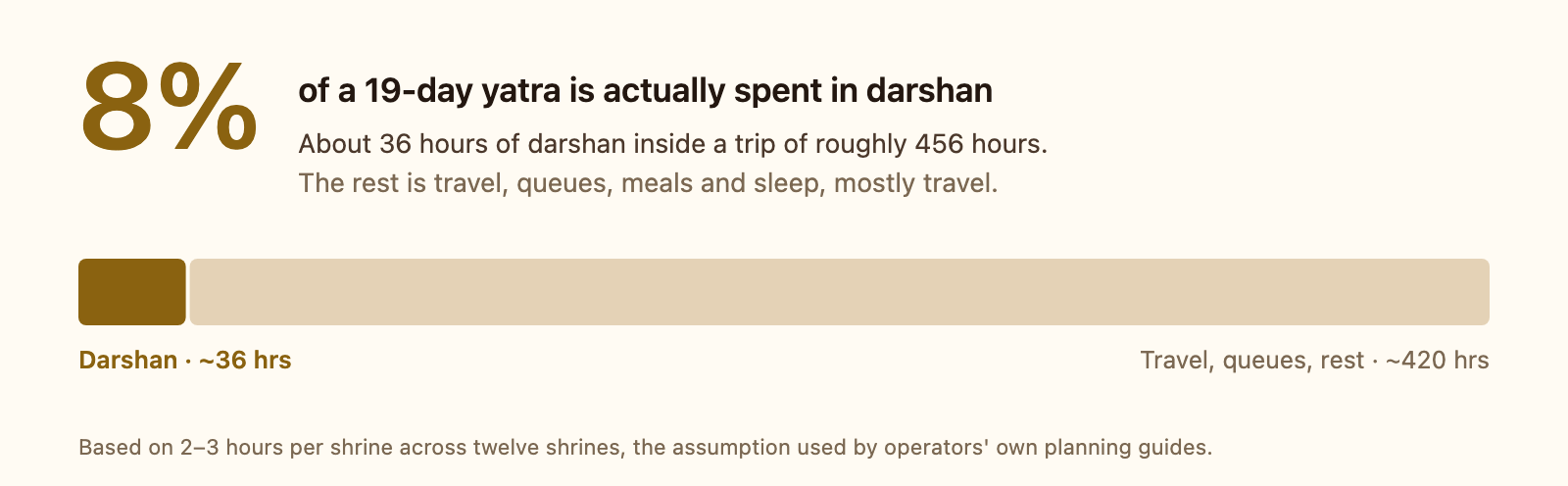
Where an 18–19 day yatra actually goes. Darshan is the thin sliver.
Roughly eight percent of the trip is darshan. The rest is travel, queues, meals and sleep, and travel is much the largest share of that. Which is why the answer to "how many days" is really an answer about geography, not devotion.
Time per shrine: the honest numbers
The twelve are not equal in what they cost you. Four eat days. The other eight eat hours. (For the daily darshan hours and aarti schedule at each one, see 12 Jyotirlinga darshan timings.)
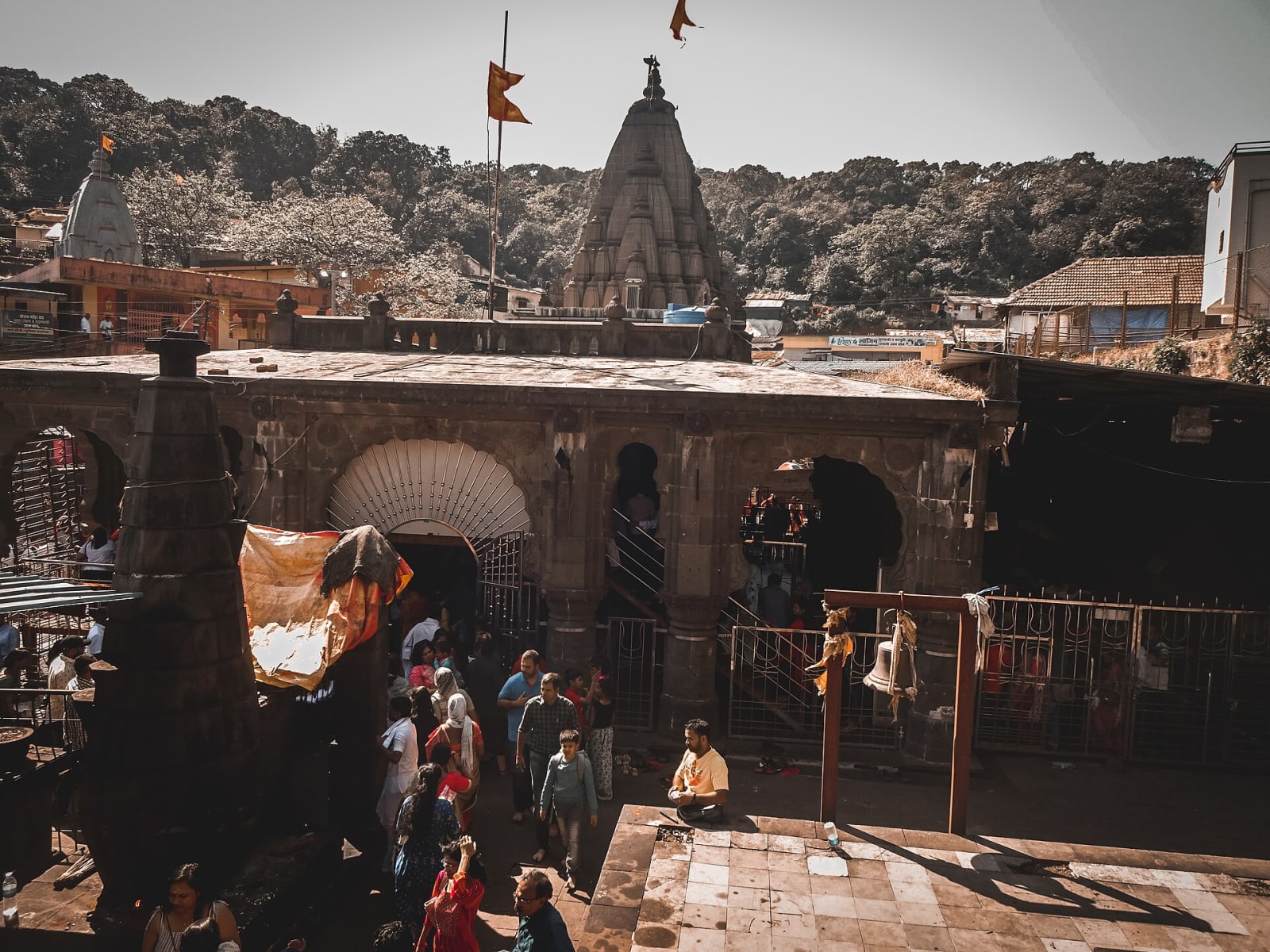
Bhimashankar sits inside a wildlife sanctuary in the Sahyadris. The last 40 km is narrow ghat road, and in July 2026 both approaches were landslide-blocked at once. Photo: Mechatron00 · CC BY-SA 4.0 · Wikimedia Commons

The four that eat days
Kedarnath: 2 full days minimum, 3 comfortably. The standard commercial leg is 2N/3D from Haridwar, and the operator selling it calls three days "objectively tight": around 800 km of driving plus a 32 km round-trip trek with no acclimatisation. The trek is 16 km each way, 6–8 hours for fit walkers and 8–10 for beginners. Pony ₹5,000–7,000 return, palki ₹15,000–22,000, or the IRCTC helicopter.
Srisailam: effectively a 2-day commitment. Hyderabad to Srisailam is 215 km and 4.5 to 6 hours, and here is the detail almost nobody publishes: the Nallamala forest gates close to all traffic, including motorcycles, from 9:00 PM to 6:00 AM. You must clear Mannanur by 8:00 PM. Arrive at 8 and there is no time for darshan and return. As one road guide puts it flatly: this is an overnight trip.
Bhimashankar: a full day from Pune, 9 to 11 hours door to door. 110 km each way, three to three and a half hours, and the final 40 km is a narrow winding ghat that should not be rushed. MSRTC bus ₹185, roughly hourly from 5 AM. Lightest traffic between 5 and 7 AM. Avoid weekends and Mondays.
And do not simply turn up. Bhimashankar was closed from 9 January to 15 June 2026 for redevelopment ahead of Simhastha 2027. On reopening, online registration became mandatory and VIP darshan, recommendation letters and protocol access were abolished outright, initially capped at 1,000 registered devotees a day. Hours were later extended to 5 AM–9:30 PM for Shravan. Register before you travel; bina registration ke darshan nahi milega.
Rameswaram: 3 to 5 hours at the temple, a full day in town. Agni Theertham sea bath 15–20 minutes, the 22 theerthams 45 minutes to 2 hours, sanctum darshan 30 minutes to 2 hours. General queue runs 1–3 hours on a typical day; the ₹200 quick-darshan ticket cuts it to 15–30 minutes.
The eight that eat hours
| Shrine | Allow | The thing to know |
|---|---|---|
| Mahakaleshwar | 3–4 hrs weekday | Queue is 1–2 hrs Tue–Thu, 4–8 hrs Monday, 10–15+ hrs on a Shravan Monday. Sheeghra darshan cuts it to 30–60 min |
| Kashi Vishwanath | 2–4 hrs, plus Varanasi is a 1–2 day city | 4–6 hrs in the general queue on a Sawan Monday. Best slots 4–6 AM or late night |
| Somnath | 2 hrs | The easiest of the twelve. 15–30 minute waits on ordinary days. Sandhya Aarti at 7 PM is the one to plan around |
| Trimbakeshwar | 45–90 min | The ₹200 pass cuts a Shravan Monday from ~8 hrs to ~45 min. Same-day offline passes sell out by 5:30 AM on peak Mondays |
| Grishneshwar | Half a day with Ellora | Under 1 km from the Ellora Caves, so most pilgrims walk between them. Men must remove their shirts for the sanctum |
| Omkareshwar | Half to full day | Mandhata island; Mamleshwar sits on the opposite bank, and in the common view the two together constitute the Jyotirlinga, so most pilgrims cross the river twice. The parikrama is 7 km |
| Nageshwar | 45–90 min | 17 km from Dwarka. Combines with Bet Dwarka in one half-day |
| Vaidyanath | Half a day | Shighra pass ₹500 is priority, not queue-free. One account reports 1.5 hours in the VIP line at peak. Basukinath is 40 km away and usually paired |
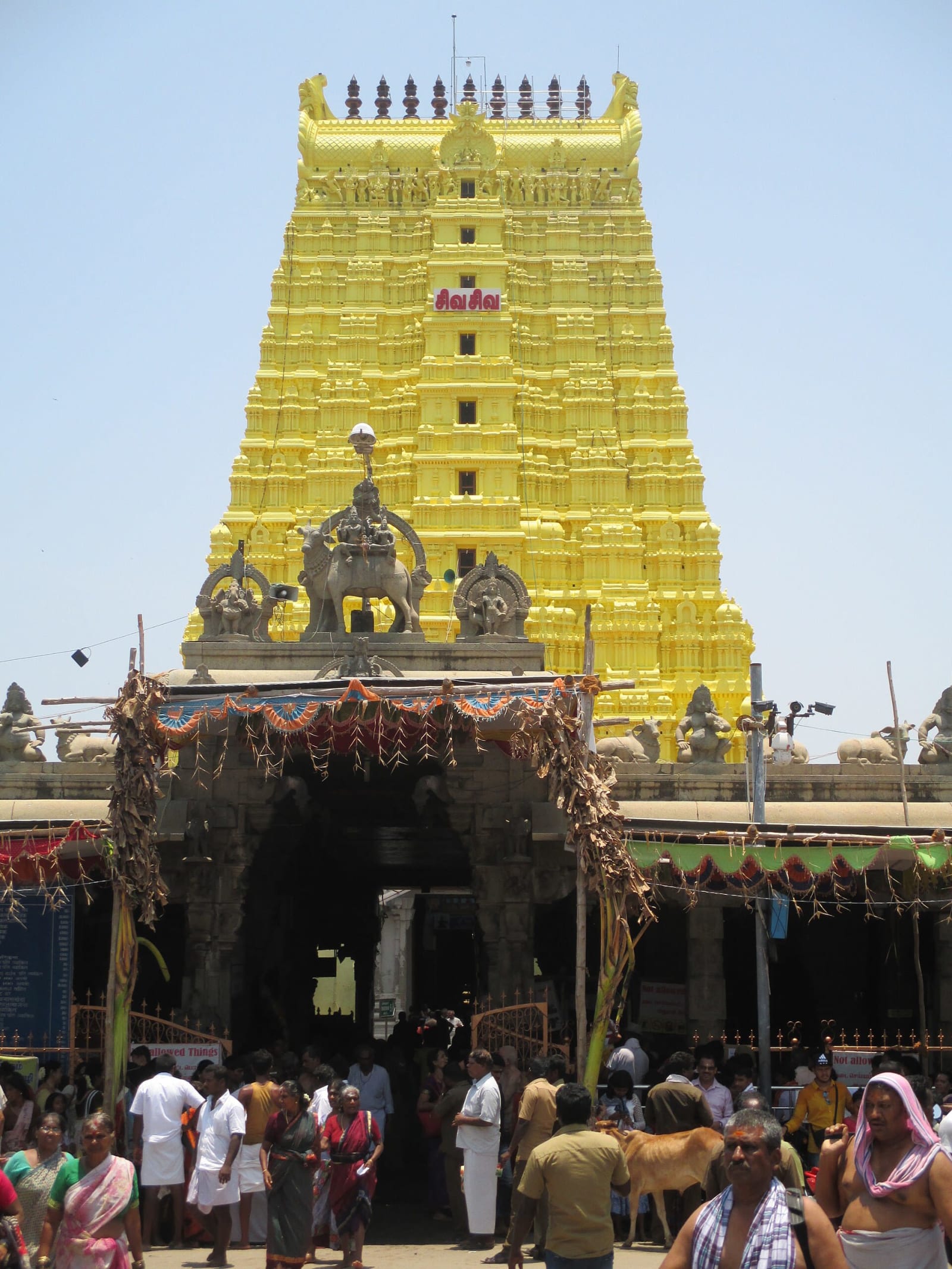
Rameswaram. Three to five hours at the temple, a full day in town, and the longest single leg of the entire yatra to get here. Photo: Ssriram mt · CC BY-SA 4.0 · Wikimedia Commons

The sane alternative: do it in clusters
Most people who finish all twelve do it over years, not weeks, and the geography quietly rewards that, because the shrines fall into four natural groups.
| Cluster | Shrines | Days | Notes |
|---|---|---|---|
| Gujarat | Somnath, Nageshwar | 4–5 | Base Ahmedabad. Add Dwarka and Bet Dwarka properly |
| Central India | Mahakaleshwar, Omkareshwar, Trimbakeshwar, Bhimashankar, Grishneshwar | 7–9 | The biggest block. MP pair needs 2 days; the Maharashtra trio 3–4 |
| South & East | Mallikarjuna, Ramanathaswamy, Vaidyanath | 6–8 | Contains the yatra's longest leg, Rameswaram to Varanasi, 2,790 km by rail |
| North | Kashi Vishwanath, Kedarnath | 3–4 | Kedarnath's window governs everything |
Split this way, you can do Gujarat in a long weekend plus two days, the Maharashtra trio in four, and save the Kedarnath leg for a September when you have a clear week. Har saal ek cluster, paanch saal mein baarah poore.
It costs more overall. It is also far easier to pay for, to get leave for, and to actually enjoy while you are there.
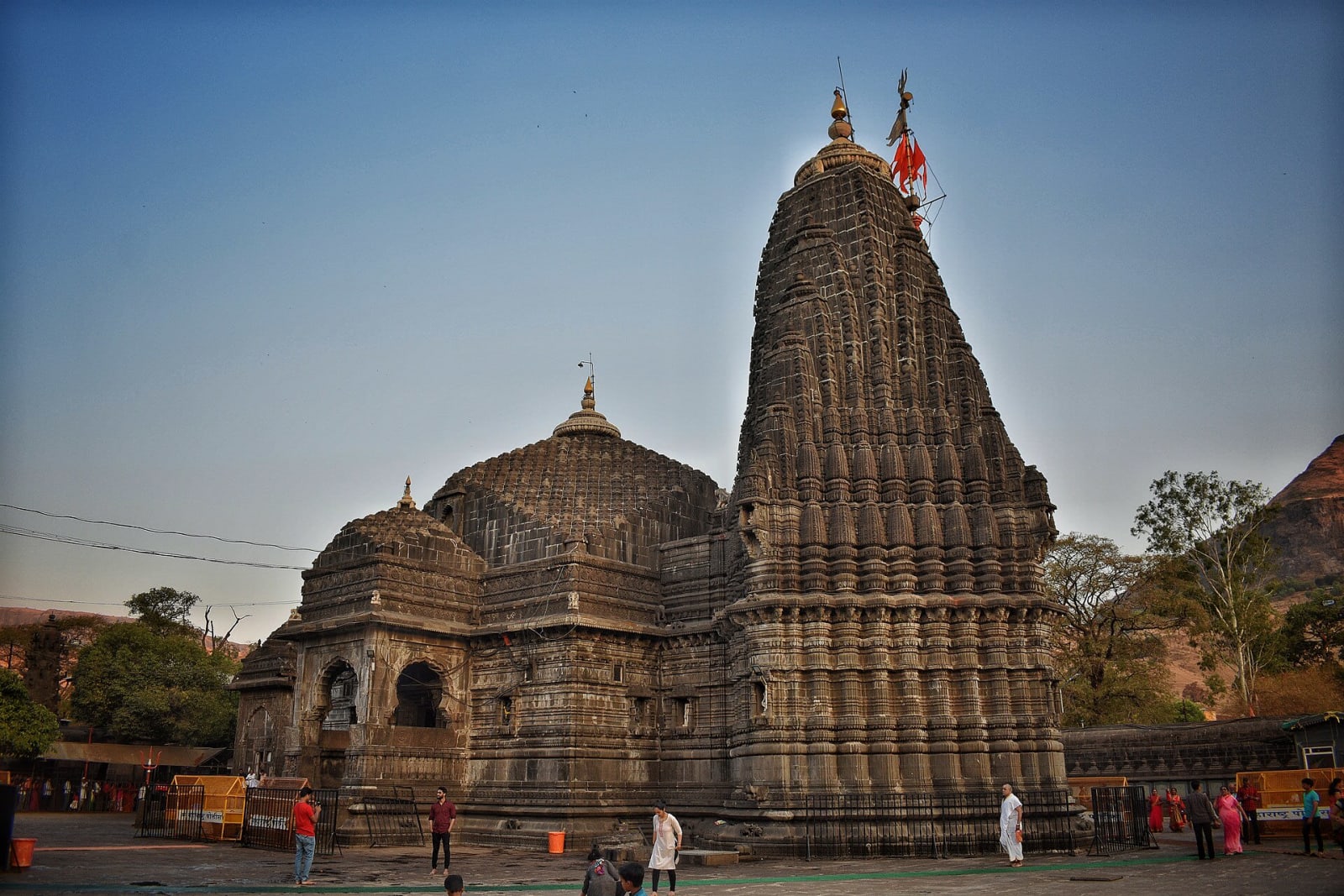
Trimbakeshwar, one of the Central India cluster. Note for 2027 planners: the Nashik–Trimbakeshwar Simhastha Kumbh begins 31 October 2026. Photo: Abhideo21 · CC BY-SA 4.0 · Wikimedia Commons

Red flags in a short package
If someone is selling you all twelve in under 15 days, check these four things before any money changes hands.
Does it include Kedarnath, and in which months? One 15-day package I looked at lists its best months as "January, February, March, October, November, December." Four of those six are months when Kedarnath is shut. The itinerary as sold cannot deliver what it promises.
Is there a "Varanasi → Kedarnath" day? The same package has exactly that as a single day. Varanasi to Guptkashi alone is a flight to Dehradun plus a seven-to-eight-hour mountain drive. Every 18-to-20-day operator gives that transition two full days.
Does Grishneshwar get a visit or a drive-past? One 24-day itinerary lists Grishneshwar on a day that also does Shirdi, Shani Shingnapur and an overnight train to Hyderabad. On paper, yes. In practice, a drive-past.
Does Srisailam appear on an actual day? It is the easiest of the twelve to quietly drop, because it is 215 km off the nearest airport through a tiger reserve with a night gate.
One last signal, and it is a loud one: I could not find a full-twelve package from SOTC, Veena World or Trip to Temples at all. What they sell is regional circuits. Even IRCTC's 18-day Bharat Gaurav product brands itself "3 Dham & 11 Jyotirlinga." When the national rail operator will not put "12" on an 18-day product, a private operator claiming twelve in twelve days deserves a hard look.
What pilgrims ask
What is the absolute minimum for all twelve?
15 days, with six or seven domestic flights and a helicopter at Kedarnath, travelling between late April and early November. Below that, something is being dropped. Aur usually woh Srisailam ya Grishneshwar hota hai.
Can I do it in winter?
You can do eleven in winter, comfortably and cheaply, with Kedarnath's winter seat at Ukhimath in place of the twelfth. What you cannot do is Kedarnath itself. Be clear with your operator about which one you are buying.
How many days for just the Maharashtra shrines?
Three to four for Bhimashankar, Trimbakeshwar and Grishneshwar. One guide claims two "without exhaustion," which is optimistic given Bhimashankar alone is a 9–11 hour day from Pune.
Is the helicopter at Kedarnath worth it?
It saves roughly a day and a half. Book only through IRCTC HeliYatra. The portal explicitly warns that travel agents claiming to book it are committing fraud. 2026 round-trip fares are Sersi ₹6,390, Phata ₹10,164 and Guptkashi ₹12,762, inclusive of 5% GST. Book 60–90 days ahead.
What about 2027?
Check the Nashik–Trimbakeshwar Simhastha Kumbh. It formally begins with Dhwajarohan on 31 October 2026 and runs to the flag-lowering on 24 July 2028, with Amrit Snans on 2 August 2027, 31 August 2027, and 11 September at Nashik and 12 September at Trimbakeshwar. Anyone planning Trimbakeshwar in that window is walking into Kumbh-scale crowds. Ujjain's Simhastha follows in 2028.
Is it better to fly or take the train?
Flying saves nine or ten days and costs roughly twice as much. The full rail picture, which shrines have a station within walking distance and which have none at all, is in our train journey guide, and the train yatra calculator works out the days and fares from your own town.
Does doing all twelve in one trip carry more merit than doing them over years?
Tradition does not say so. The Dwadasha Jyotirlinga Stotram, the verse most pilgrims know by heart, promises its merit to whoever recites the twelve names morning and evening. It says nothing about seeing them in one journey, or even in one lifetime. Each darshan is complete in itself. Doing all twelve in a single trip is a practical decision about leave and money, not a spiritual requirement, and many families take one cluster a year. Shraddha ginti se nahi, bhaav se hoti hai.
Related reading
- 12 Jyotirlinga Yatra Cost in 2026. official temple rate cards, the real IRCTC fares, and why quotes vary fourteen times over
- 12 Jyotirlinga Train Journey. every railhead, every named train, and the four shrines rail cannot reach
- 12 Jyotirlinga Darshan Timings. opening hours, afternoon closures and aarti schedules for all twelve, with live open-or-closed status
- Train Yatra Calculator. the days and fares by rail from your own town
- Plan your route. order all twelve into the shortest sensible circuit from your city
Sources and confidence
Strong: Kedarnath 2026 opening (government announcement, multiple outlets); 2025 and 2024 closing dates (official); Char Dham registration rules and IRCTC HeliYatra fares (euttaranchal, official portal); Mahakaleshwar queue-time table (simhastha.org.in); Bhimashankar July 2026 landslide closures (tirthayatra.org); Nallamala forest gate timings (milemarked road guide); Nashik Simhastha 2027 dates (official mela site).
Reasonable: operator itineraries and day counts, all read from the operators' own live pages: Waytoindia, Memorable India, Tourism of India, Indian Holiday, Kanaiya, Atlas Travel, MyTicketsToIndia, Thomas Cook, Root Indians, TrekGo, Shrine Yatra, Nagarjuna Travels.
Flagged as uncertain: the 11 November 2026 closing date is expected, not formally confirmed. It matches Bhai Dooj and four sources agree, but final confirmation comes on Vijayadashami. Kedarnath's trek distance appears as both 16 km and 19 km (16 is standard; 19 may measure from Sonprayag). Its altitude appears as both 3,583 m and 3,553 m. Ukhimath's altitude appears as both 1,300 m and 1,145 m. The Omkareshwar parikrama duration is my estimate at pilgrim pace; no source gives a figure.
Not found: queue times in hours for Srisailam, Omkareshwar and Baidyanath on ordinary days; any genuine 7-day, 9-day or 11-day all-twelve package, despite searching specifically; published darshan timings for the Omkareshwar Temple at Ukhimath.
A note on drive times. Journey-planner estimates are systematically optimistic for Indian roads. One gave Dwarka–Ujjain, 676 km, as "7 hours." Every time above is either an operator-stated figure or a planner estimate with a realism adjustment, and the two are distinguished in the text.
Last verified: 16 September 2026. Kedarnath's dates move every year and its closing date is the single thing most worth re-checking before you book.