Why 12 Jyotirlinga Formed: What the Texts Say
Why 12 jyotirlinga formed, as devotional tradition tells it: the pillar of light, the Shiva Purana's 64, and what no source can prove.
The short answer
In short: Why 12 Jyotirlinga formed has a devotional answer, not a dated one. Tradition says Shiva appeared as a pillar of light, and the Shiva Purana is said to name 64 such places, with 12 held most sacred.
I went looking for a reason for the number twelve. Didn't find one. Not in the pages that rank for this question, and not in anything I could read directly. What I found is a story, a short list, and a few honest gaps, all of it tradition, told as tradition.
Every one of the twelve has its own page on 12 Jyotirlinga, with the legend as that shrine's priests and pilgrims tell it, and the list with places is there too. Nobody is selling you anything on this page.
The pillar of light, as tradition tells it
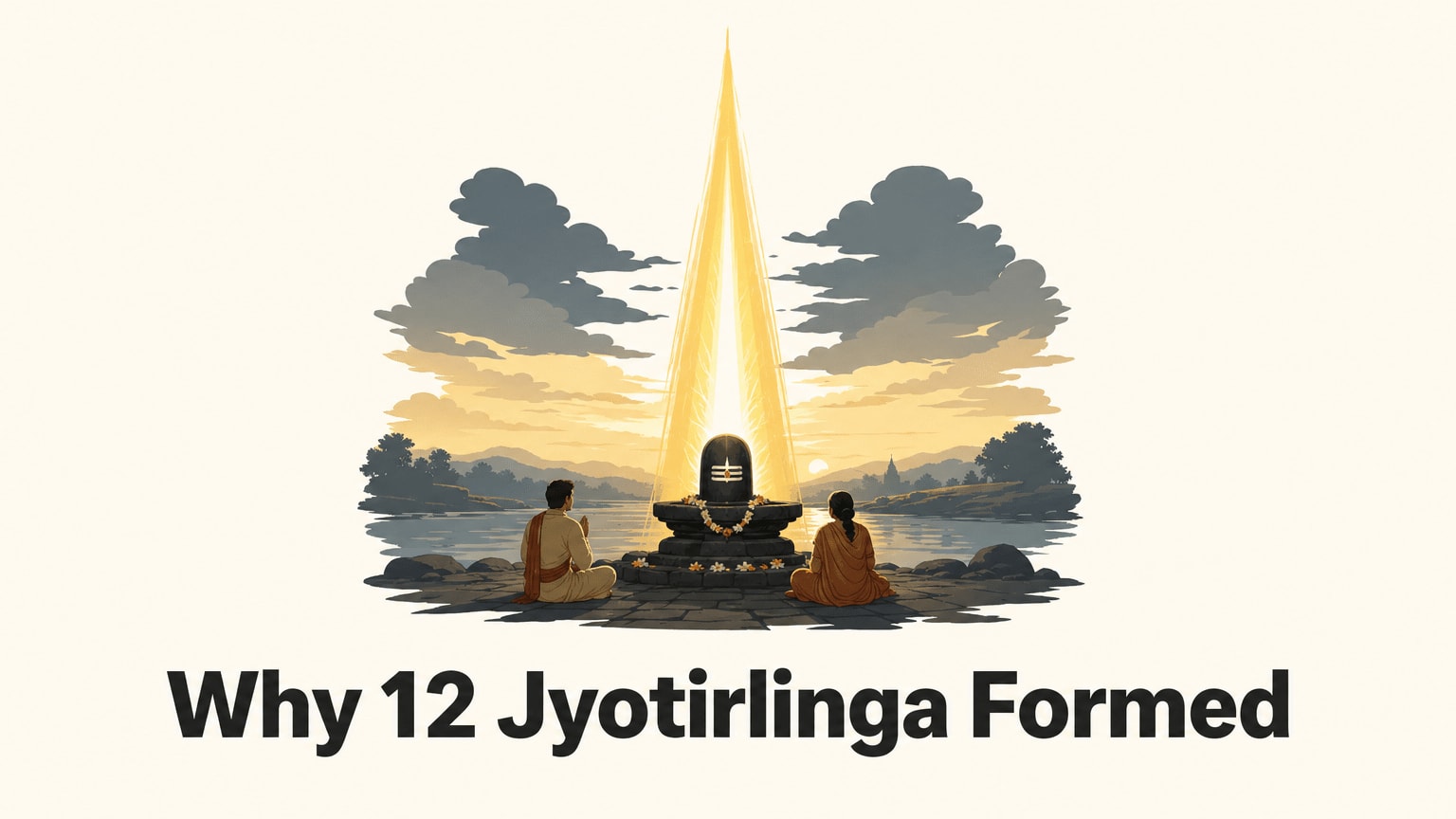
It starts with an argument. In a legend from the Shiva Purana, Brahma and Vishnu each claimed to be supreme. Shiva ended it by appearing as an infinite pillar of light that pierced the three worlds.
So the two set out to test it. Brahma went up, Vishnu went down, each looking for an end. In some tellings Vishnu takes the form of the boar Varaha, and Brahma rides a swan. Neither could find where the light stopped.
Vishnu came back and admitted it. Brahma did not.
Brahma later claimed, falsely, that he had found the end of it. Shiva cursed him: he would not be worshipped. That's the point of the story as it is told. Supremacy fails. The light remains.
The detail people remember is the proof Brahma offered: a ketaki flower. Tradition says Shiva was angered by the lie, and that Vishnu, for his honesty, would be worshipped always. Brahma got the curse. Vishnu got the praise. A dispute about who is greater ended with a lesson about telling the truth.
That column of light is the jyotirlinga, Shiva's manifestation as light, and the shrines are regarded as the temples where Shiva appeared in that form, though Open magazine adds a distinction worth knowing: every jyotirlinga is a lingam that appeared on its own, but not every self-appeared lingam is a jyotirlinga.

The word itself is a plain compound. Jyotis is radiance and lingam is a sign, so jyotirlinga reads as "lingam of light", as Wikipedia glosses it. A sign of light, not a statue of a god. That is why the legend matters more here than any building date.
Pehle ek baat saaf kar doon. This is a devotional account, not a historical one. Nobody can date the column of light. I won't pretend to.
Where twelve comes from: 64, then the short list
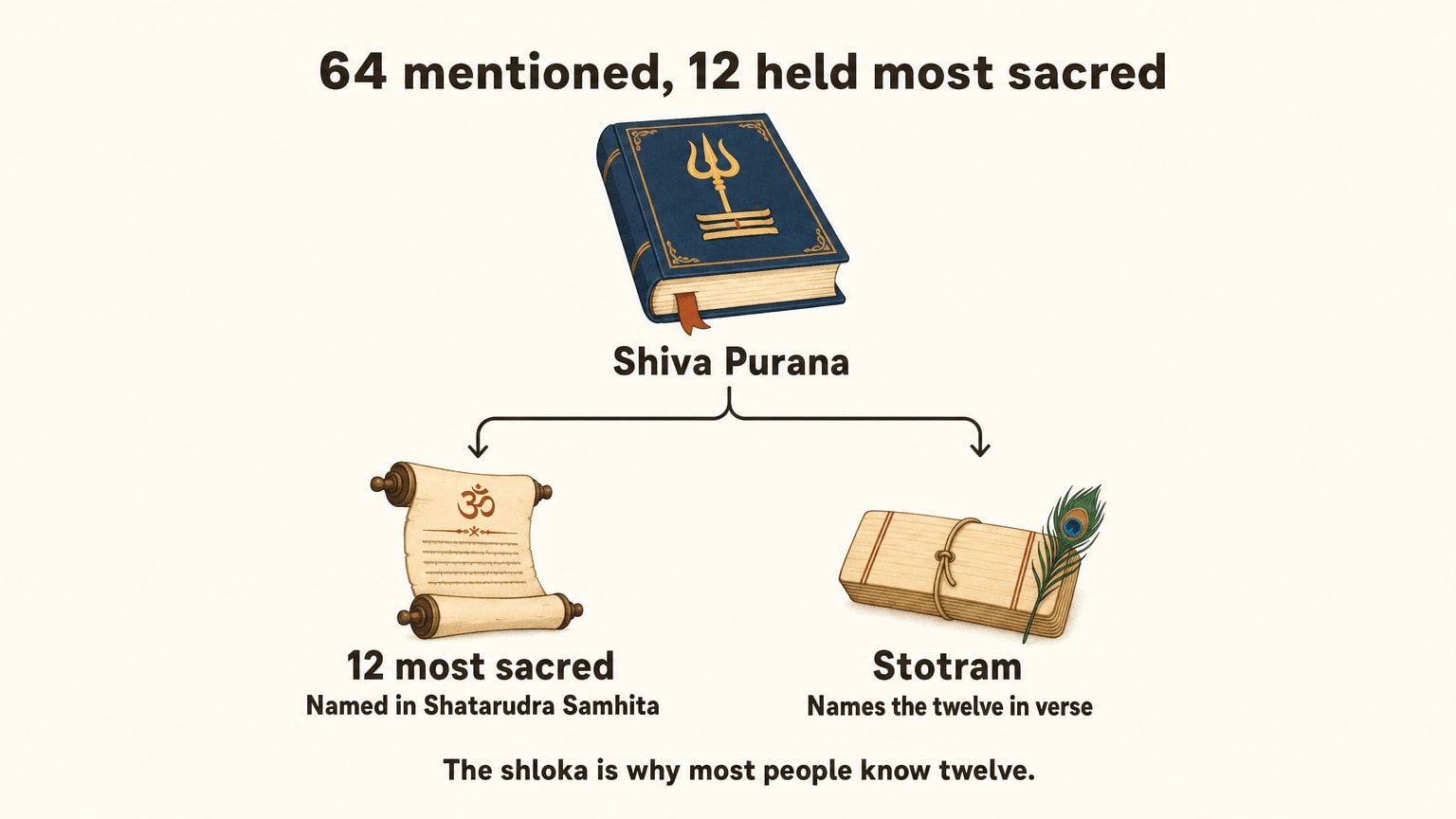
Most guides skip this part. The Shiva Purana is said to mention 64 jyotirlingas, and 12 of those are considered very auspicious and holy. So twelve is a selection, not the whole of what the tradition once counted.
The twelve are named in the Shatarudra Samhita, chapter 42, verses 2 to 4. Long stories of each shrine sit in the Kotirudra Samhita, chapters 14 to 33. An essay in Open magazine points out the same split: an overview in one, the detailed accounts in the other.
Most people never learned twelve from a Purana, though. They learned it from a shloka. The Dvadasha Jyotirlinga Stotram names all twelve in verse, and that is the count that stuck. One verse says that whoever recites the names every evening and morning is relieved of the sins of past lives. That is the text's own line, quoted as the text says it. Not a promise from me.
What the texts say and what they leave open
Why twelve and not ten, or sixty-four? I could not source an answer. Vedantu tells the pillar story and then says only that these are the 12 major Jyotirlingas in the Shiva Purana. Why twelve? It doesn't say. I found no page that ties a reason to a text, so I offer none.
Each shrine also has its own story of why Shiva stayed there. Per the Open magazine essay, Somnath is tied to the moon god Chandra. At Omkareshwar, the tradition says Vindhya worshipped a lingam and Shiva let it stay as a jyotirlinga. Vaidyanath is tied to Ravana, and Rameswaram to Rama. Different stories for different places, which is partly why a single "formation" answer does not exist.
The detail is where it gets good. Take Somnath. In the tradition the moon was cursed, bathed in the Sarasvati river there and prayed to Shiva, and was cured. The essay notes that Chandrakunda still exists at the temple in Gujarat, so the story has a place you can point to.
At Omkareshwar, Mount Vindhya worshipped Shiva with a parthiva lingam (one shaped from earth), which the essay says was shaped like AUM. To fulfil Vindhya's wish, Mahadeva manifested himself, and Shiva granted that it would stay as a jyotirlinga.
Vaidyanath has the most human story. Ravana worshipped Shiva and offered his heads one by one. Shiva healed him, which is why he is called a physician, a vaidya. A related anecdote has Ravana trying to carry the lingam to Lanka. He was tricked into setting it down, and it would not move again. At Rameswaram the lingam is the one Rama established. Tradition says he was granted victory there.
Read together, they are not one origin story. Some shrines come from a curse, some from a wish, some from a rescue. Each is told by its own people about its own ground.
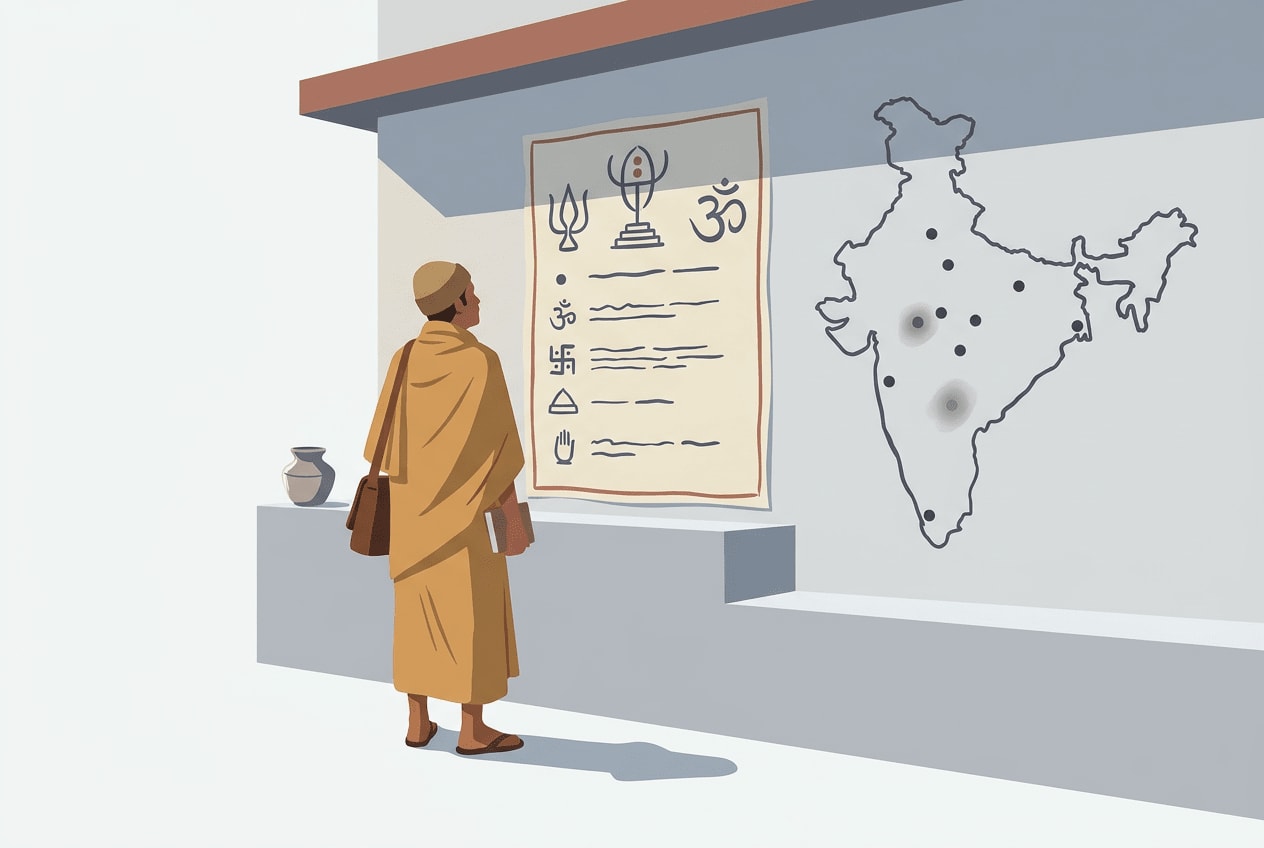
The map is less settled than the list. The same essay says that ten of the twelve can be identified unambiguously on the ground. The two it calls less certain are Bhimashankar and Nageshwar.
What is tradition, what is documented, what is open
| Question | What I could read | Status |
|---|---|---|
| Who formed them? | Shiva, as a pillar of light, in the Shiva Purana legend | Tradition |
| How many? | 64 mentioned, 12 held most sacred | Tradition, from the text |
| Where are they named? | Shatarudra Samhita, chapter 42 | Text reference |
| Why twelve? | No source found | Open |
| Are all twelve places certain? | Ten identified unambiguously | Disputed for two |
Source: Wikipedia, Jyotirlinga and Open magazine, Pillars of Light
Nageshwar and the places still argued over
A pilgrim can meet the Nageshwar question on the road. The usual identification is the temple near Dwarka. Open magazine says plainly that this identification is not proven. Some traditions claim the title for Aundha Nagnath in Maharashtra and for Jageshwar in Uttarakhand.
So if someone tells you their Nageshwar is the real one, they may be right by their tradition. The shrine page for Nageshwar has the legend and how to reach it.
The story behind the name, as the essay gives it, is a rescue. A rakshasa named Daruka was destroying dharma and had imprisoned Supriya, a devotee and a king of vaishyas. Shiva killed Daruka. The trouble is that the whole identification hangs on where Darukavana was, and nobody has pinned that down.
Bhimashankar has a similar problem. Dakini is the region the text mentions, and placing that on a map is hard. Pilgrimage accepts the usual site near Pune. Did the text mean exactly that place? That's a scholar's question, and not one I can settle.
The legend there is about Bhimasura, whom Shiva destroyed, and a devotee he protected, the king of Kamarupa. Per the essay, this text names the king Sudakshina, where other places name Priyadharma. The usual identification is the temple near Pune, but a temple near Guwahati is also associated with the story.
Frequently asked questions
Who made the 12 Jyotirlingas?
According to the Shiva Purana legend, nobody built them. Shiva appeared as a pillar of light, and the shrines are regarded as the places of that appearance. Many hands built and rebuilt the temples, as buildings, over time. The legend is about the light, not the masonry.
Why are there 12 Jyotirlingas and not more?
Tradition counts more. The Shiva Purana is said to mention 64, with 12 considered very auspicious. I found no text that explains why the count settled at twelve. Most people know the number because the Dvadasha Jyotirlinga Stotram names twelve.
Is the pillar of light story history?
No. It's devotional tradition.
Are all twelve locations certain?
Not all. Open magazine says ten can be identified unambiguously. Nageshwar and Bhimashankar are the two where the identification is less sure. Pilgrims visit the accepted sites; scholars mostly own the question.
Where can I read about each shrine's own legend?
Each shrine has its own page on 12 Jyotirlinga with the legend, dress code and how to reach it, for example Somnath. Darshan hours are on a separate page, and you should confirm them on the official temple portal before you travel.