Darshan
Free general darshan. A paid VIP pass is sold at the counter and shortens the wait considerably on weekends, Mondays and through Shravan.
trimbakeshwartrust.com ↗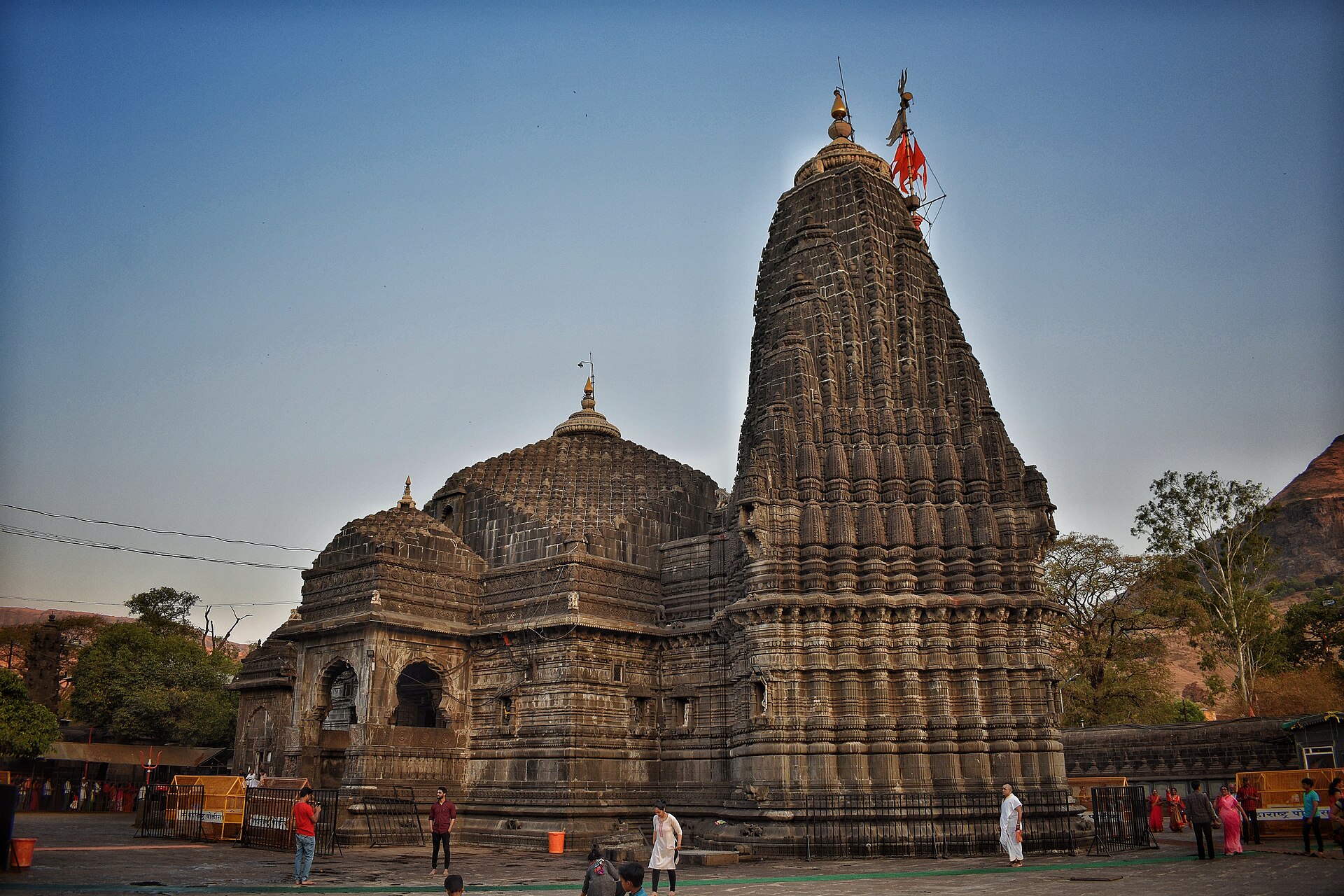
Below Brahmagiri hill, where the Godavari rises, sits the only jyotirlinga with three faces — Brahma, Vishnu and Shiva in a single stone. It is also the great temple of ancestral rites, where families come to settle debts older than themselves.
A sage was tricked into sin.A river was brought down to wash it.The Godavari still runs from that hill.
Why Shiva is here, and not somewhere else — as the Shiva Purana and local tradition tell it.
The sage Gautama lived on Brahmagiri and, through a boon, had grain when the world had famine. Envious sages sent an illusory cow into his field. It died at his touch, and he was condemned for the killing of a cow — a sin with no ordinary remedy.
Gautama did penance until Shiva appeared, and asked that the Ganga be brought to the hill to wash the sin away. Shiva released a strand from his hair. The river descended and became the Godavari — the Dakshin Ganga, the Ganga of the south.
Gautama asked that Shiva remain. He did, and the lingam here bears three small faces in a hollow — Brahma, Vishnu and Shiva — worn low by centuries of abhishek and covered each day in a silver mask. Because the sin washed away here was ancestral in weight, Trimbakeshwar became the foremost place in India for the rites of the dead.
Times shown in IST. The status above is live against the temple's published hours.
Open daily with a short closure around 12:30 PM for the midday puja. Sanctum entry is restricted during abhishek hours; the general queue continues outside.
What can be booked, what is free, and where the official channel actually is.
Free general darshan. A paid VIP pass is sold at the counter and shortens the wait considerably on weekends, Mondays and through Shravan.
trimbakeshwartrust.com ↗Three-day ancestral rites performed only on astrologically permitted days, and only by authorised temple priests. Costs commonly run ₹25,000 and upward depending on the ritual. Book directly with the Trust or a registered pujari — never through a street tout.
Trust booking ↗Widely performed here; requires a priest consultation and a date fixed against your horoscope. Arrange in advance rather than on arrival.
For sanctum entry and abhishek, a white dhoti with an upper cloth is expected. Ordinary modest clothing is fine for the general queue.
Saree or salwar-kameez. Note that entry into the innermost sanctum has historically been restricted — check current practice at the temple office.
Trimbak, near Nashik, Maharashtra — 19.9333°N, 73.53°E
Limited flights. Mumbai (~180 km) is the practical airport for most travellers.
On the Mumbai–Bhusawal line with frequent trains from Mumbai. Buses and taxis run to Trimbak from the station and the CBS stand.
Nashik ~28 km with buses every half hour. Mumbai ~180 km (4 hrs), Pune ~230 km, Shirdi ~115 km. Shirdi is a very common add-on.
November to February is most pleasant. The monsoon turns Brahmagiri green and dramatic and is beautiful, if wet. April–May is hot. Shravan Mondays and Maha Shivaratri bring the largest crowds of the year.
The sacred tank where the Godavari is considered to formally begin. Kumbh bathing happens here.
The river's true source and a full parikrama route. Dawn climb, spectacular in monsoon.
Believed to be Hanuman's birthplace; a popular short trek.
Ramkund, Kalaram temple and Sita Gufa — the Ramayana's exile country.
Freely-licensed photographs from Wikimedia Commons. Each is credited to its photographer.

.jpg)
.jpg)
Pilgrimage vlogs from independent travellers on YouTube — the walk in, the queue, the darshan. Nothing loads until you press play.
Light a lamp for Trimbakeshwar and it stays lit across the site — your progress towards all twelve is remembered on this device.