Darshan
Free and unticketed. The temple is small, so even moderate crowds fill the courtyard — early morning is a different experience entirely.
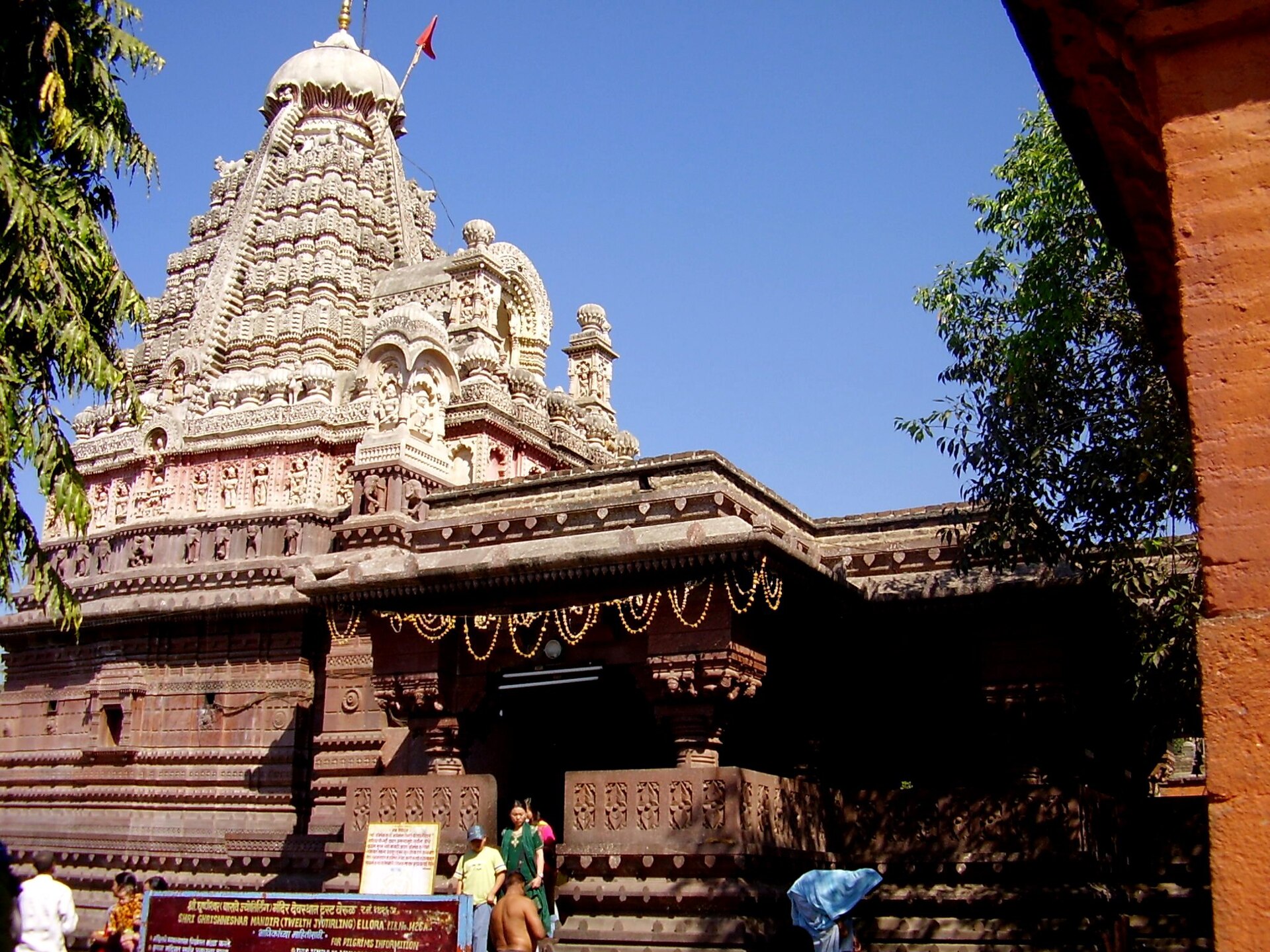
A kilometre from the Ellora caves, in red basalt raised by Ahilyabai Holkar, stands the twelfth and final jyotirlinga — the smallest of them all, and the one whose story is about a woman who did not stop believing after her son was murdered.
A son killed out of jealousy.A mother who kept her routine.A lake that gave him back.
Why Shiva is here, and not somewhere else — as the Shiva Purana and local tradition tell it.
The brahmin Sudharma and his wife Sudeha were childless. Sudeha persuaded him to marry her sister Ghushma, a devotee of Shiva who made a hundred and one clay lingams every day, worshipped them and set them in the lake. Ghushma bore a son.
Sudeha watched the household turn towards her sister, and one night she killed the boy and threw his body into the same lake. In the morning Ghushma was told. She did not scream, and she did not stop — she made her hundred and one lingams, worshipped them, and walked to the lake to set them down.
Her son walked out of the water alive. Shiva appeared, furious, and would have destroyed Sudeha — and Ghushma asked him to forgive her sister instead. Moved, Shiva agreed to remain there forever, in the name of the woman whose faith had not moved: Ghushmeshwar, Grishneshwar.
Times shown in IST. The status above is live against the temple's published hours.
A break falls between 3:00 and 5:30 PM. During Shravan and Maha Shivaratri hours extend dramatically — opening as early as 3:00 AM and closing at 11:00 PM.
What can be booked, what is free, and where the official channel actually is.
Free and unticketed. The temple is small, so even moderate crowds fill the courtyard — early morning is a different experience entirely.
Touching the lingam is permitted here, subject to the dress rule for men. This is what draws many pilgrims specifically to Grishneshwar.
Sponsored abhishek and rudrabhishek are arranged at the temple office; ask in the morning.
This is the strictest dress rule of the twelve. Men entering the sanctum must remove their shirt and vest and wear a dhoti — bare-chested entry is required. Saffron dhotis are available to hire outside the temple.
Saree or chudidar. Jeans and western wear are not permitted for sanctum entry.
Verul, beside Ellora, Maharashtra — 20.0269°N, 75.179°E
Flights from Mumbai, Delhi and Hyderabad. Taxi to Verul takes about 45 minutes.
Connected to Mumbai, Pune, Nagpur and Hyderabad. Buses and taxis run to Ellora regularly.
Aurangabad ~30 km, Pune ~250 km, Mumbai ~350 km, Shirdi ~130 km. MSRTC buses run to Ellora throughout the day.
November to February is ideal, and doubles as the best season for the Ellora caves. March to May is very hot in Marathwada. The monsoon is green and pleasant but the caves get slippery.
Thirty-four rock-cut Hindu, Buddhist and Jain caves. Kailasa temple, Cave 16, was carved downward from a single rock.
A hill fortress with a legendary spiral defensive passage. A steep, rewarding climb.
Aurangzeb's son's memorial to his mother — the Deccan's answer to the Taj.
Second-century BCE Buddhist caves with the finest surviving ancient painting in India.
Freely-licensed photographs from Wikimedia Commons. Each is credited to its photographer.


Pilgrimage vlogs from independent travellers on YouTube — the walk in, the queue, the darshan. Nothing loads until you press play.
Light a lamp for Grishneshwar and it stays lit across the site — your progress towards all twelve is remembered on this device.