12 Jyotirlinga Train Journey: Every Route and Real Cost
No train covers all twelve, and none is planned. Five shrines are a walk from the platform, four sit well beyond the rail network, and the station named after Omkareshwar has no usable trains. Here is every railhead, every named train, and what the whole circuit actually costs in Sleeper, 3AC and 2AC.

The shore at Rameswaram, back on the rail map since the new Pamban bridge opened in April 2025. Photo: M.Mutta · CC BY-SA 3.0 · Wikimedia Commons

Contents
- Five things that changed, which most guides still get wrong
- The short answer
- The railhead table
- Leg by leg: the trains that actually run
- The trains named after the shrines
- The IRCTC trains, and why the Jyotirlinga-branded ones do seven
- What the whole circuit actually costs
- Where rail simply does not go
- Booking: what changed, and what will catch you out
- What pilgrims ask
- Related reading
- Sources and confidence
Indian Railways will take you to within walking distance of five Jyotirlingas. It will take you within an auto ride of three more. For the remaining three, plus Kedarnath which is a category of its own, it leaves you a long way short. On a bus, on a ghat road, or on foot.
That is the real shape of a rail yatra, and almost nothing written about it says so.
Most of what is online about this is also out of date in ways that will cost you a booking. So before the routes, five corrections.
Five things that changed, which most guides still get wrong
1. Aurangabad station is now Chhatrapati Sambhajinagar, and the code changed from AWB to CPSN. Effective 25 October 2025. If you search IRCTC for AWB looking for your Grishneshwar connection, you may not find it.
2. Somnath station is shut. SMNH has been closed for redevelopment since 22 September 2022, and services have been terminating at Veraval (VRL), 6 km from the temple. Book to Veraval. The new terminal is a ₹157 crore project designed with twelve shikhars echoing the temple, but it is not open yet. (As of September 2026 the station still shows zero trains on the booking aggregators and is still described as under construction. Check SMNH on IRCTC before you book.)
3. The station called "Omkareshwar Road" has essentially no trains. It sits 12 km from the temple on an unconverted metre-gauge line under gauge conversion, and a search for Ujjain to Omkareshwar Road returns nothing at all. The real railhead for Omkareshwar is Khandwa (KNW), 72 km away, or Indore (INDB), 77 km. The Mhow–Sanawad gauge conversion that would fix this has not been completed. There is one useful middle option most guides miss: a daily broad-gauge MEMU runs Khandwa–Sanawad, and Sanawad is only about 17 km from the temple. This is the single most common error in Jyotirlinga rail guides.
4. The advance booking window is 60 days, not 120. Cut on 1 November 2024. Booking opens at 08:00 IST. No change in 2026.
5. Rameswaram trains are back, but only since April 2025. The 1914 Pamban bridge was permanently closed to rail in December 2022, and the new vertical-lift bridge opened 6 April 2025. Speed is capped at 75 km/h, and 50 km/h across the lift span.
Ab in paanch cheezon ke baad, asli baat shuru karte hain.
The short answer
A self-planned twelve-shrine rail yatra costs roughly, in train tickets alone:
- Sleeper: ₹8,000 to ₹10,000
- 3AC: ₹16,000 to ₹18,000
- 2AC: ₹21,000 to ₹24,000
That is about 9,500–10,000 rail kilometres, plus roughly ₹3,300–5,500 of unavoidable road and last-mile costs, before a single night's accommodation or meal.
For your own starting city, dates, class and group size, the train yatra calculator works the whole thing out, leg by leg.
IRCTC's Bharat Gaurav "07 Jyotirlinga Yatra" charges ₹23,505–24,100 in Sleeper including hotels, all meals, transfers and a tour manager, but visits seven shrines, not twelve. The Deluxe AC version of the same seven starts at ₹88,810. A separate 18-day Deluxe product does eleven of the twelve, from ₹1,46,545.
No train covers all twelve. None is planned. I went looking for one, properly, and it does not exist.

Somnath. The station named after it sits 1.4 km away and has been closed since 2022. Book to Veraval, 6 km out. Photo: B. SurajPatro1997 · CC BY-SA 4.0 · Wikimedia Commons
.jpg)
The railhead table
Station codes matter here, because that is what you actually type into IRCTC.
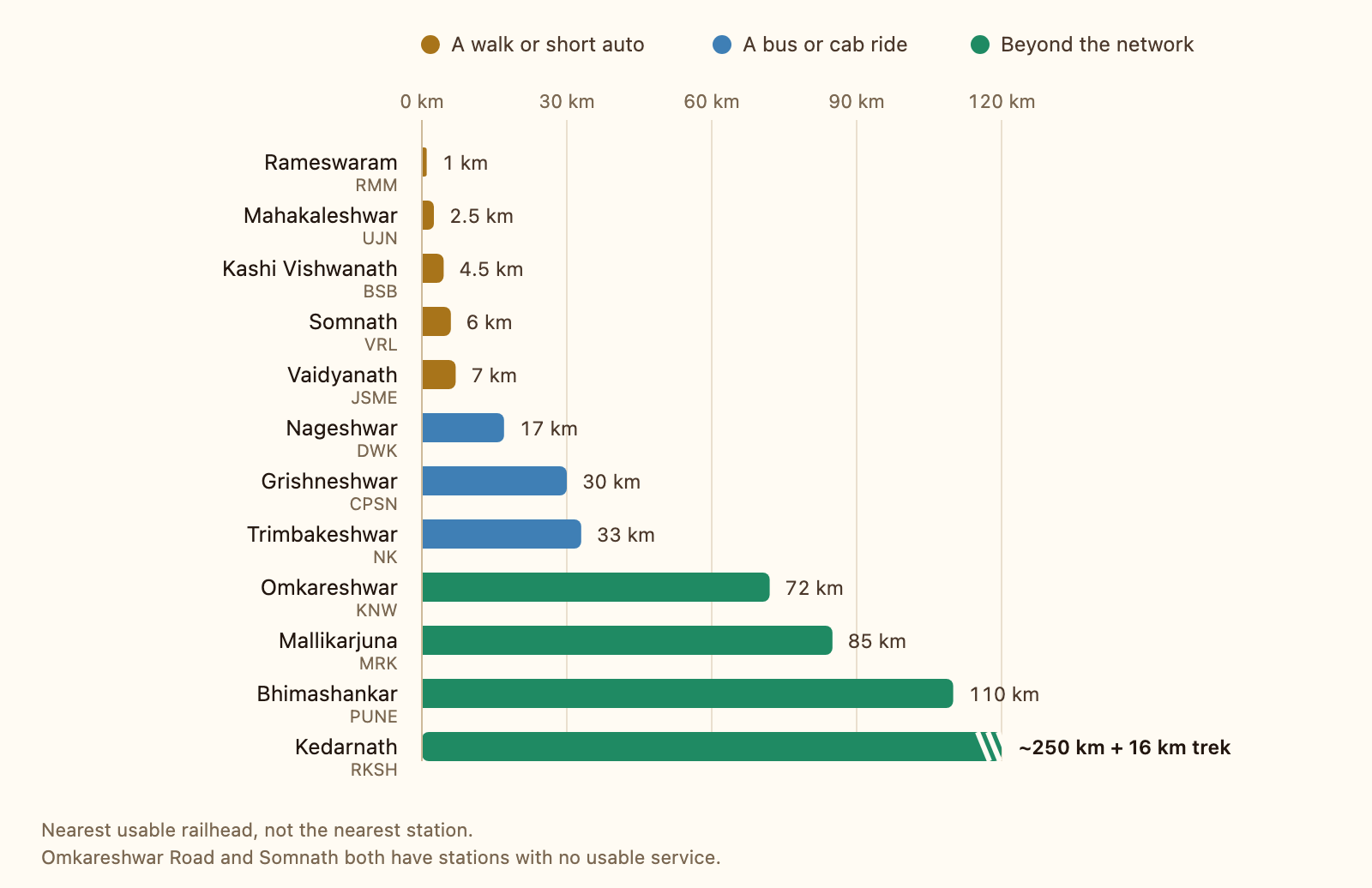
How far the train leaves you from the shrine. Five are a walk; Kedarnath needs 250 km of mountain road and a 16 km trek.
| # | Jyotirlinga | Railhead | Code | To temple | Last mile |
|---|---|---|---|---|---|
| 1 | Rameswaram | Rameswaram | RMM | 1 km | Walk, or a two-minute auto |
| 2 | Mahakaleshwar | Ujjain Jn | UJN | 2–2.5 km | Auto ₹40–80; walkable in 25 min |
| 3 | Kashi Vishwanath | Varanasi Jn (Cantt) | BSB | 4.5 km | Auto ₹30–50, then on foot through the lanes |
| 4 | Somnath | Veraval Jn | VRL | 6 km | Auto/taxi, 10–20 min |
| 5 | Vaidyanath | Jasidih Jn | JSME | 7 km | Auto, taxi or shared jeep, 24×7 |
| 6 | Nageshwar | Dwarka | DWK | 17 km | Shared auto ₹40–50/head; bus ₹15–20; taxi ₹600–900 |
| 7 | Trimbakeshwar | Nashik Road | NK | 32–35 km | Shared jeep ₹50–80; MSRTC bus ₹30–50; cab ₹400–600 |
| 8 | Grishneshwar | Chhatrapati Sambhajinagar | CPSN | 30 km | Cab ₹700–1,000; MSRTC bus ₹40–60 |
| 9 | Omkareshwar | Khandwa Jn (not Omkareshwar Road) | KNW | 72 km | State bus ₹80–150; shared jeep ~₹100; taxi ₹1,500–2,000 |
| 10 | Mallikarjuna | Markapur Road | MRK | ~85 km | APSRTC bus, ~2 h 15 m; first service 05:40 |
| 11 | Bhimashankar | Pune Jn | PUNE | ~110 km | MSRTC bus ₹185, ~3.5 h, hourly 05:00–16:00. Online registration now mandatory |
| 12 | Kedarnath | Rishikesh / Haridwar | RKSH / HW | ~210–250 km + 16 km trek | Bus 10–12 h, shuttle ₹50, then trek 6–8 h |
Five of twelve are within 7 km of a platform. Three more are a straightforward auto or bus. Three sit outside the network altogether. And Kedarnath is its own problem entirely.
By distance, roughly 90% of the circuit is rail. The trouble is that the other 10% holds four of the twelve shrines, and it will eat a wildly disproportionate share of your days and your budget. The network gets you near eleven of twelve. It gets you to about five.
Leg by leg: the trains that actually run
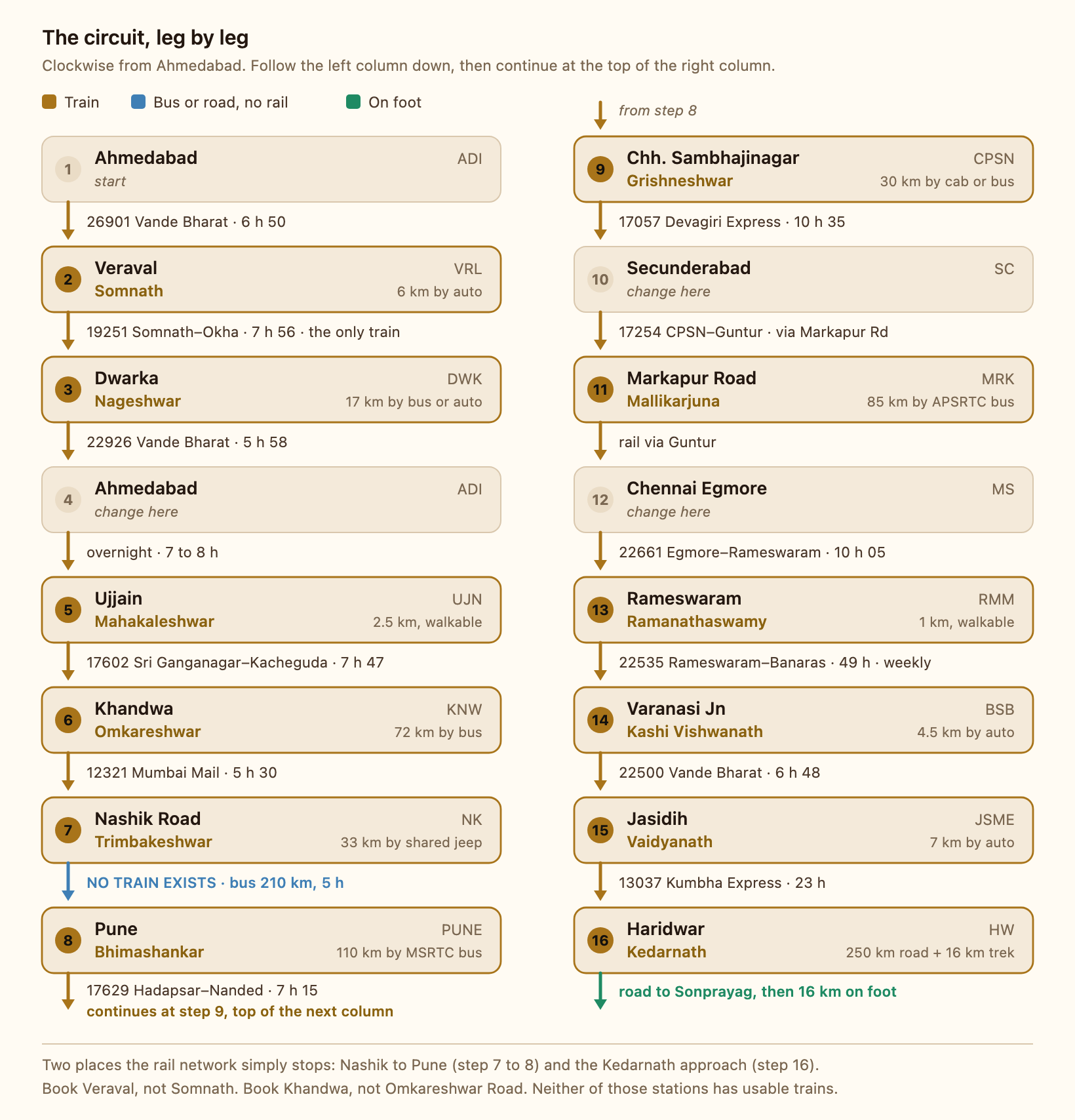
The whole circuit in one picture. Sixteen stops, fifteen legs, and the two places the track simply runs out.
Take this route with you
All sixteen stops on one page, with every station code and train number. Print the PDF, or keep the image on your phone for the journey. Setting out from somewhere else? The train yatra calculator runs this circuit from your own town, with dates and fares.
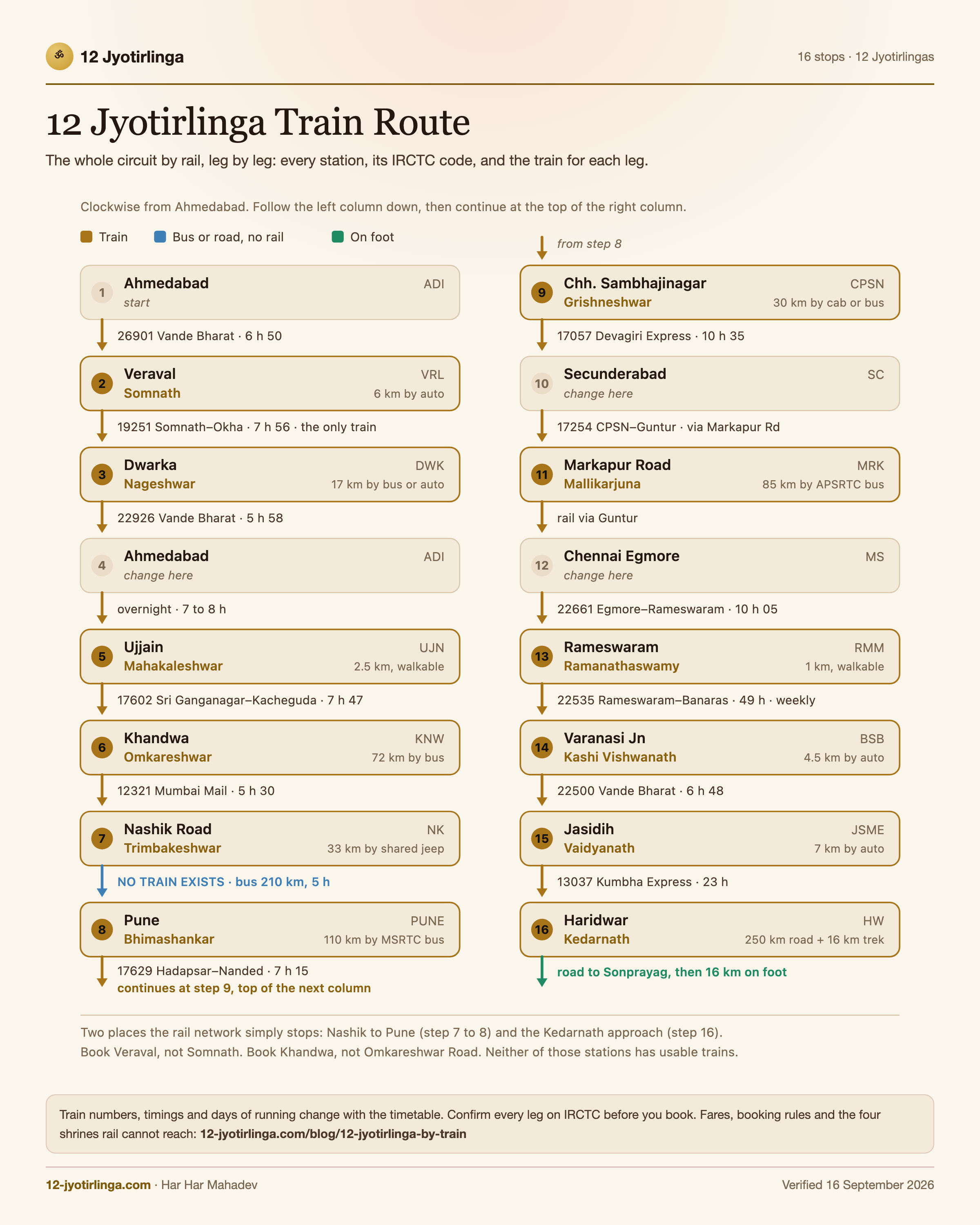
Routed clockwise from Ahmedabad. One field to double-check on IRCTC yourself: days of running. Schedule aggregators render them inconsistently, and I would not bet a trip on them.
Gujarat
Ahmedabad → Veraval (Somnath), 431 km. Twelve trains. The fastest is 26901 Sabarmati–Veraval Vande Bharat, 06:00 → 12:50, just under seven hours, six days a week (not Thursdays). Overnight alternative: 22957 Somnath Express (which actually originates at Gandhinagar Capital), 21:45 → 05:45, with 2A/3A/SL. From Rajkot it is 184 km and about four hours.
Veraval → Dwarka (Nageshwar), 413 km, and there is exactly one train. 19251 Somnath–Okha Express, daily, 23:05 → 07:01. Fares ₹130 general to ₹1,625 in 1A. This single overnight is the only direct Somnath–Dwarka rail link, which makes it a real scheduling constraint. Plan around it rather than assuming you have options.
Dwarka → Ahmedabad. Thirteen trains, most about eight hours. Fastest is 22926 Okha–Ahmedabad Vande Bharat at 5 h 58 m, which halts at Dwarka. Also 22946 Saurashtra Mail and the wonderfully useful 16734 Okha–Rameswaram Express (more on that below).
Madhya Pradesh
Ahmedabad → Ujjain (Mahakaleshwar), 427 km. Seventeen trains, mostly overnight at seven to eight hours. No Vande Bharat on this corridor.
Ujjain → Omkareshwar. Yahan map jhooth bolta hai. There is no usable train to Omkareshwar Road. Go Ujjain → Khandwa by rail (six trains, fastest is 17602 Sri Ganganagar–Kacheguda at 7 h 47 m), then 72 km by road. In practice most pilgrims go Ujjain to Indore, then Indore to Omkareshwar by bus, and that is the sane way round it.
Maharashtra
Khandwa → Nashik Road (Trimbakeshwar), 380 km. Forty trains, most around five and a half hours. Take your pick of the classics: 12321 Mumbai Mail, 22178 Mahanagari Express, 12533 Pushpak Express, 12138 Punjab Mail. Note there are no direct trains from Indore or Ujjain to Nashik Road. You route via Khandwa or Bhopal.
Nashik Road → Pune (Bhimashankar): no through train exists. Not a bad train. Not an inconvenient one. Koi train hi nahi hai. There is no direct line between Nashik and Pune, and no through service in either direction. (They are connected by rail only the long way round, via Manmad, Ahmednagar and Daund.) The long-promised semi-high-speed line had its direct alignment scrapped in June 2026 and replaced with a longer route via Ahilyanagar and Shirdi. This leg is bus or car, about 210 km, five hours, ₹400–600. It is the biggest single hole in a rail-only circuit. Do bilkul aas-paas ke shrine, aur beech mein koi patri nahi.
Pune → Chhatrapati Sambhajinagar (Grishneshwar), 415 km by rail. Only one regular train, and it does not leave from Pune Jn: 17629 Hadapsar–Nanded Express, daily, 21:50 → 05:05, 7 h 15 m. The line loops via Daund and Manmad, so it covers 415 rail km to bridge about 230 road km. The road beats it on time; the train wins only by running overnight and saving you a hotel night.
The South
Chhatrapati Sambhajinagar → Secunderabad. Well served, fifteen trains. 17057 Devagiri Express and 17063 Ajanta Express are the daily workhorses; 16734 Okha–Rameswaram is fastest at 9 h 35 m.
Secunderabad → Markapur Road (Mallikarjuna), 317 km. Four trains, and two of them leave from Charlapalli and one from Kacheguda, not Secunderabad Jn. Worth knowing before you arrive at the wrong station. The pick is 17254 CPSN–Guntur Express, daily, because it runs all the way from Chhatrapati Sambhajinagar to Guntur via Markapur Road. Two legs in one booking.
Chennai Egmore / Madurai → Rameswaram. Seven trains from Chennai over 600 km. 22661 Chennai Egmore–Rameswaram SF, daily, 17:55 → 04:00, is the clean overnight. From Madurai it is under three hours; 16343 Amritha Express does it in 2 h 50 m.

Rameswaram returned to the rail map only in April 2025, when the new Pamban vertical-lift bridge opened. The station is a kilometre from the temple, the shortest last mile of the twelve. Photo: M.Mutta · CC BY-SA 3.0 · Wikimedia Commons

The long haul east and north
Rameswaram → Varanasi, 2,790 km. The longest single hop on the circuit, and there is a direct train: 22535/22536 Rameswaram–Banaras SF Express, weekly, departing Rameswaram on Wednesday at 23:55 and taking about 49 hours 15 minutes. One booking, Ramanathaswamy to Kashi Vishwanath. From Chennai the fastest is 12390 Chennai–Gaya SF at 34 h 18 m.
Varanasi → Jasidih (Vaidyanath), 430 km. The best-served leg on the whole circuit, with twenty-three trains. 22500 Varanasi–Deoghar Vande Bharat, 06:10 → 12:58, six days a week (not Tuesdays), CC around ₹550. Or the overnight 22466 Baba Vaidyanath Dham Express at 6 h 25 m.
Jasidih → Haridwar (for Kedarnath), 1,225 km. Only two trains, and they are the same service on different days: 13037 Kumbha Express (Mon/Wed/Thu/Sat/Sun) and 13035 Upasana Express (Tue/Fri), both departing 16:50 and arriving 15:50 the next day. Between them you get a daily 16:50 departure and a 23-hour run.
The trains named after the shrines
A small pleasure of this circuit. Indian Railways has named a surprising number of trains after the places you are heading to.

Kashi Vishwanath. Four different named trains will bring you here from a Jyotirlinga: from Rameswaram, from Somnath, from Dwarka and from Indore. Photo: Gannu03 · CC BY-SA 4.0 · Wikimedia Commons

- Kashi Mahakal Express (20415/20416). Varanasi to Indore, 1,074 km, about 17 h 45 m, weekly, 3AC. Introduced in February 2020 and built expressly to connect Kashi Vishwanath, Mahakaleshwar and Omkareshwar in a single booking. It is the closest thing Indian Railways has to a purpose-built Jyotirlinga train.
- Baba Vaidyanath Dham Express (22466) and its Humsafar (22460). both named for the Deoghar shrine, both doing Varanasi to Jasidih in 6 h 25 m.
- Kashi Tamil Express (16367). Kanniyakumari to Banaras, weekly, about 51 hours. The name says exactly what it is for.
- Somnath Express (22957). Gandhinagar Capital through Ahmedabad to Veraval, overnight.
- 22535/22536 Rameswaram–Banaras SF. the two-day shrine-to-shrine special.
- 16734 Okha–Rameswaram Express. the single most useful train on the circuit. It touches Dwarka/Okha for Nageshwar, Chhatrapati Sambhajinagar for Grishneshwar, and runs Madurai to Rameswaram. One train, three shrines' worth of work.
The IRCTC trains, and why the Jyotirlinga-branded ones do seven
More people get confused here than anywhere else in this subject, so let us be exact.
IRCTC runs two Bharat Gaurav trains branded as Jyotirlinga products, and a third that goes much further.
The two Jyotirlinga-branded ones cover exactly the same seven shrines: Mahakaleshwar, Omkareshwar, Nageshwar, Somnath, Trimbakeshwar, Bhimashankar and Grishneshwar. Both omit Kedarnath, Kashi Vishwanath, Vaidyanath, Rameswaram and Mallikarjuna, all five of the geographically awkward ones. Neither is, nor claims to be, a twelve-Jyotirlinga train. The catalogue name on one of them is literally Sapta Jyotirlinga Mahayatra. Sapta. Saat.
The third one is the interesting one, and hardly anybody writes about it: "Dev Darshan Yatra: 3 Dham & 11 Jyotirlinga" (package code CDBG41), a Deluxe AC train running 17 nights and 18 days from Delhi Safdarjung. It covers eleven of the twelve. Everything except Kedarnath, and that includes Rameswaram and Srisailam. Fares run ₹1,46,545 to ₹2,21,955. Note which one is missing. Even a rail product willing to spend eighteen days on this cannot include Kedarnath, because no train goes there and the temple is shut half the year in any case.
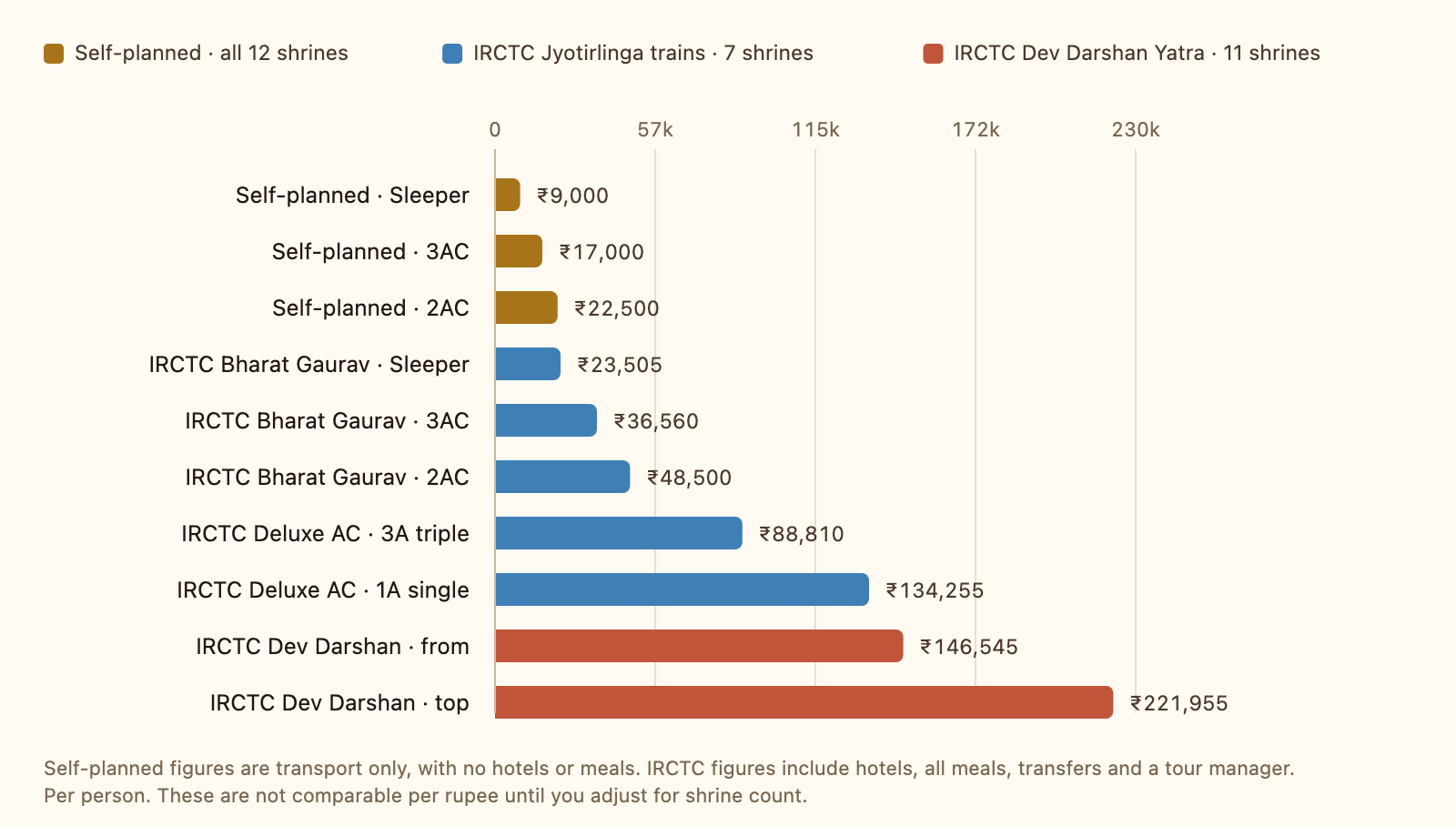
Self-planned rail tickets against the IRCTC packages. Note the shrine count; these are not comparable per rupee until you adjust for it.
The ordinary Bharat Gaurav Tourist Train, the "07 Jyotirlinga Yatra". This is a recurring product with several regional editions, each with a different origin, duration and price. There is no single "the" seven-Jyotirlinga train.
| Edition | Duration | Sleeper | 3AC | 2AC |
|---|---|---|---|---|
| Delhi Safdarjung, May 2026 | 12 days | ₹23,505 | ₹36,560 | ₹48,500 |
| Yog Nagri Rishikesh, Nov 2025 | 12D/11N | ₹24,100 | ₹40,890 | ₹54,390 |
Both of those departures have already run. They are here as a price guide to a recurring product, not as bookable dates. Check irctctourism.com for the current calendar.
Capacity on the Rishikesh edition is 767 passengers: 648 in Sleeper, 70 in 3AC, 49 in 2AC. Fares include roughly a 33% concession under the Bharat Gaurav scheme. Also running: a 13-day edition from Amritsar, and a "Sapta Jyotirlinga Darshan Yatra" from Vijayawada with fifteen boarding points across AP, Telangana and Maharashtra.
The Bharat Gaurav Deluxe AC Tourist Train, the "Sapta Jyotirlinga Mahayatra". A completely different product, package code CDBG45, departing 25 September 2026 from Delhi Safdarjung for 11 days.
| Class | Single | Twin | Triple |
|---|---|---|---|
| Superior AC First (1A) | ₹1,34,255 | ₹1,19,425 | ₹1,17,305 |
| Deluxe AC Two Tier (2A) | ₹1,24,755 | ₹1,09,925 | ₹1,07,805 |
| Comfort AC Three Tier (3A) | ₹1,05,760 | ₹90,930 | ₹88,810 |
So the same seven shrines cost ₹23,505 at the bottom and ₹1,34,255 at the top, very nearly six times the price. What you buy with the difference is 3-star hotels instead of dharamshalas, AC vehicles for every transfer, entry tickets, and local guides.
Included on both: travel in your booked class, accommodation, all vegetarian meals, road transfers and sightseeing, accidental travel insurance, an IRCTC tour manager, onboard security. Excluded on both: temple entry fees, special and VIP darshan tickets, guide tips, personal expenses.
That last exclusion matters more than it looks. The official darshan rate cards are not large. Somnath is free, Trimbakeshwar's pass is ₹200. But Bhasma Aarti at Ujjain and sanctum entry are separate, and on a packed group itinerary you will want them.
What the whole circuit actually costs
Built on a fourteen-leg clockwise routing: Ahmedabad → Veraval → Dwarka → Ahmedabad → Ujjain → Khandwa → Nashik Road → (bus) Pune → Chhatrapati Sambhajinagar → Secunderabad → Markapur Road → Chennai → Rameswaram → Varanasi → Jasidih → Haridwar. The train yatra calculator runs this same circuit from any town in India.
| Class | Rail tickets | Plus road/last mile | Rough total, transport only |
|---|---|---|---|
| Sleeper | ₹4,500 – 4,700 | ₹3,300 – 5,500 | ₹8,000 – 10,000 |
| 3AC | ₹12,200 – 12,500 | ₹3,300 – 5,500 | ₹16,000 – 18,000 |
| 2AC | ₹17,600 – 18,000 | ₹3,300 – 5,500 | ₹21,000 – 24,000 |
Some verified point-to-point fares, so you can sanity-check any quote:
| Leg | km | Sleeper | 3AC | 2AC |
|---|---|---|---|---|
| Rameswaram → Varanasi | 2,790 | ₹845 | ₹2,235 | ₹3,335 |
| Jasidih → Haridwar | 1,225 | ₹520 | ₹1,410 | ₹2,050 |
| Chennai Egmore → Varanasi | 1,870 | ₹685 | ₹1,835 | ₹2,705 |
| Chennai Egmore → Rameswaram | 600 | ₹330 | ₹905 | ₹1,295 |
| Varanasi → Jasidih | 430 | ₹255 | ₹685 | ₹985 |
| Ahmedabad → Ujjain | 427 | ₹255 | ₹685 | ₹985 |
| Pune → Chhatrapati Sambhajinagar | 415 | ₹250 | ₹675 | ₹965 |
| Khandwa → Nashik Road | 380 | ₹235 | ₹630 | ₹900 |
These are Mail/Express base fares. They exclude reservation, superfast and GST surcharges, so expect the actual ticket to run 10–20% higher. Rajdhani, Duronto, Humsafar and Vande Bharat are priced separately and higher.
The road costs you cannot avoid, per person: Nashik→Pune ₹400–600 · Pune→Bhimashankar return ~₹370 · Khandwa→Omkareshwar return ₹160–300 · Nashik Road→Trimbakeshwar return ₹60–160 · CPSN→Grishneshwar return ₹80–120 · Dwarka→Nageshwar return ₹30–100 · Markapur→Srisailam return ₹900+ · Haridwar→Sonprayag return ₹1,200–1,800 · Sonprayag→Gaurikund shuttle ₹50 each way. And at Kedarnath, on top of all of it: pony about ₹3,000–3,500 one way (₹5,000–6,000 return), palki ₹8,000–12,200 one way (₹15,200–18,200 same-day return), or the IRCTC helicopter at ₹6,390–12,762 return.

Omkareshwar on Mandhata island. There is a station called Omkareshwar Road 12 km away. It has no usable trains. Photo: Deveshc92 · CC BY 4.0 · Wikimedia Commons

Where rail simply does not go
Roughly in order of how much trouble each one causes you.
Kedarnath. Rail ends at Rishikesh or Haridwar. Then 210–250 km of mountain road, ten to twelve hours, then a 5 km shuttle, then a 16 km trek. The Rishikesh–Karnaprayag line that would shorten this is still under construction. Roughly 270 km of the approach has no rail at all, and the temple is only open from late April to about 11 November, which is a whole planning problem of its own. We covered it in how many days the yatra takes.
Nashik to Pune. No direct line and no through train. The semi-high-speed project's direct alignment was scrapped in June 2026, but in the same announcement it was replaced by a longer Pune–Ahilyanagar–Shirdi–Nashik route, parts of which are already built. For now this severs Trimbakeshwar from Bhimashankar, the two Maharashtra shrines that look adjacent on a map.
Bhimashankar. 110 km of ghat road from Pune Jn, with nothing closer. Two live cautions. First, the temple was closed from 9 January to 15 June 2026 for redevelopment, and on reopening online registration became mandatory while VIP darshan and recommendation letters were abolished. Register before you travel. Second, in July 2026 both approach roads were blocked by landslides simultaneously and pilgrims were told to postpone; access appears to have been restored by the August Shravan season, but check before you go.
Srisailam. No station in the town. Markapur Road at 85 km is nearest, and many pilgrims skip rail entirely and take the APSRTC bus from Hyderabad, 212 km in four to five hours.
Omkareshwar. A station bearing its name, 12 km away, with no usable service. It sits on the old metre-gauge alignment, and the gauge conversion is still unfinished. Khandwa at 72 km is the practical answer, though the Khandwa–Sanawad MEMU gets you to within 17 km.
Somnath. A station 1.4 km from the temple, closed since 2022. Veraval at 6 km is the real answer.
Booking: what changed, and what will catch you out
The window is 60 days, cut from 120 on 1 November 2024. Booking opens at 08:00 IST. For a circuit with a weekly train on it, and Rameswaram–Banaras is weekly, 60 days is tighter than it sounds. Work backwards from your one fixed date and book that leg first.
Aadhaar verification is now effectively mandatory. Yeh wali cheez sabse zyada logon ko pareshan karti hai. From 1 July 2025 Tatkal required Aadhaar-linked accounts; from 15 July 2025, Aadhaar OTP confirmation. From October 2025, general online booking in the first 15 minutes after a window opens is restricted to Aadhaar-verified users. If your IRCTC account is not verified, you will just fail at 08:00 and again at 10:00, with no useful error message to tell you why. Pehle account verify karwa lijiye, warna us subah kuch haath nahi aayega.
Tatkal opens one day before travel, at 10:00 for AC classes and 11:00 for non-AC. Maximum four passengers per ticket. Authorised agents are blocked for the first 30 minutes of each window to give individuals a clear run. Confirmed Tatkal tickets are generally non-refundable. Charges run roughly ₹100–200 in Sleeper, ₹300–400 in 3AC, ₹400–500 in 2AC.
Senior citizen concessions are still suspended. The pre-2020 rates, 40% for men over 60 and 50% for women over 58, have not returned as of 2026, and tickets are issued at full price. What does survive is automatic lower-berth allocation for seniors, women over 45 and pregnant women, subject to availability: roughly six or seven lower berths per Sleeper coach, four or five per 3AC.
Divyangjan concessions are still in force: 75% for orthopaedically handicapped and paraplegic passengers in 2S, Sleeper, First, AC Chair Car and 3AC; 50% for blind and low-vision passengers. The escort gets the same rate. You need a Divyangjan ID or recognised disability certificate linked to your IRCTC profile, and you must carry the originals.
There is no pilgrimage quota. The official list runs to seventeen categories, from General, Ladies, Senior Citizen, Tatkal, Premium Tatkal, Foreign Tourist, Defence, Physically Handicapped, Duty Pass, RAC, Parliament House, Roadside, Pooled, Cancer Patient, Yuva, Railway Employees and Emergency, and not one of them is for pilgrims. Several pilgrimage blogs imply otherwise. They are simply wrong.
What pilgrims ask
Can I do all twelve entirely by train?
No. Four shrines, Kedarnath, Bhimashankar, Srisailam and Omkareshwar, sit beyond the network, and there is no rail line at all between Nashik and Pune. About 90% of the circuit by distance is rail; the last 10% contains a third of the shrines.
Which single train covers the most Jyotirlingas?
16734 Okha–Rameswaram Express. It touches Okha/Dwarka for Nageshwar, Chhatrapati Sambhajinagar for Grishneshwar, and runs the Madurai–Rameswaram stretch. For pure intent, though, the Kashi Mahakal Express wins, because it was created specifically to link Kashi Vishwanath, Mahakaleshwar and Omkareshwar.
Is the IRCTC Bharat Gaurav package worth it?
For seven shrines with hotels, meals, transfers and a tour manager handled, ₹23,505–24,100 in Sleeper is good value, and hard to beat doing it yourself once you price in accommodation. Just be clear it is seven, and plan the other five separately. The Deluxe AC version at ₹88,810 and up is the same seven shrines in considerably more comfort.
How far ahead should I book?
The window is 60 days. Book your scarcest leg first. That means Veraval–Dwarka, which has exactly one train, and Rameswaram–Varanasi, which runs weekly.
Sleeper or 3AC?
Over a circuit this long, 3AC works out about ₹8,000 more than Sleeper in total. On the two-day Rameswaram–Varanasi haul and the 23-hour Jasidih–Haridwar run, most people find that money well spent. Chhoti legs par Sleeper bilkul theek hai.
What about the whole trip's cost, not just the trains?
Transport is roughly 45–60% of a self-planned yatra. Accommodation, food, darshan tickets and offerings make up the rest. The full breakdown is in our 2026 cost guide.
Is a rail yatra slower?
Yes, and meaningfully so. Flying gets all twelve into 15–18 days; a rail-based circuit needs about 24. About a week of your life, traded for about half the cost. Aapko decide karna hai ki kaunsi cheez zyada mehngi hai.
Related reading
- How Many Days Does the Full 12 Jyotirlinga Yatra Take?. the durations that actually work, and the six months when the twelve-shrine yatra is impossible
- 12 Jyotirlinga Yatra Cost in 2026. official temple rate cards and where the money really goes
- Train Yatra Calculator. this circuit from your own town: every train, the days, and the fares for your class and group
- 12 Jyotirlinga Darshan Timings. when each temple is open, so a train arrival does not land you at a shut door
- Plan your route. the shortest sensible circuit from your city
Sources and confidence
Strong: station rename AWB→CPSN (news coverage plus live train names); the 60-day booking rule and Aadhaar mandates (government releases); Tatkal timings; the Divyangjan and senior-citizen concession position; the absence of any pilgrimage quota (official PIB quota list); New Pamban Bridge opening date and speed restrictions; both IRCTC Bharat Gaurav products' shrine lists, confirmed independently across five sources; the Deluxe AC fare table, corroborated by three outlets.
Reasonable: all named trains, numbers and timings, read from live schedule data on the routes linked above; point-to-point base fares from the same source.
Flagged as uncertain: Somnath (SMNH) station status. The 2022 closure is documented, booking aggregators show zero trains there as of September 2026, and it is still described as under construction, but I found no formal statement of a reopening date. Book Veraval. Bhimashankar road access after the July 2026 landslides. The August Shravan arrangements imply access was restored, but I could not find an explicit reopening notice. Days-of-running on several trains rendered inconsistently in the schedule data; confirm on IRCTC. The Markapur Road to Srisailam distance (~85 km) and the first APSRTC service at 05:40 are single-sourced. A further "07 Jyotirlinga Yatra" edition quoted at ₹18,000/₹27,400/₹35,500 rests on a single low-authority source and is deliberately left out of the table and the ranges above.
Not found: any Maharashtra or MP state-tourism rail package covering Jyotirlingas; any privately operated Bharat Gaurav train marketed as a Jyotirlinga product; and, after searching specifically, any rail product covering all twelve. The closest is IRCTC's 18-day Dev Darshan Yatra at eleven.
Last verified: 16 September 2026. Train numbers and timings change with the timetable; fares change more often. Confirm on IRCTC before you book anything on this page.