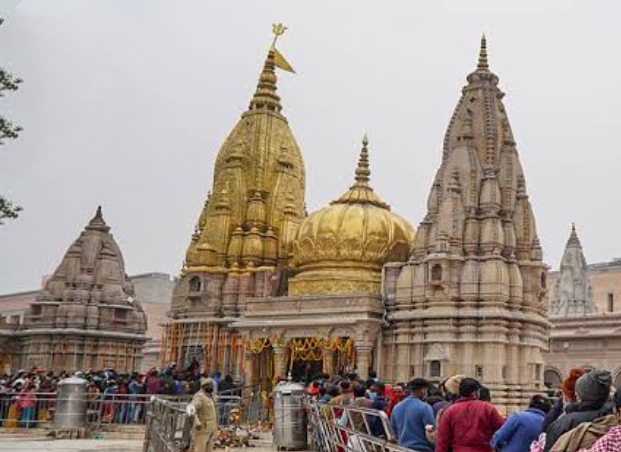
How it is told
What is the story of Kashi Vishwanath?
A house away from the father-in-law
The story starts domestically. Parvati did not want to keep living at her father's; Shiva went looking for a city of their own and settled on this bend of the Ganga. To keep it out of the reach of the earth and of the earth's ending, he set it on the tip of his trident. That is the claim behind the name Avimukta, the never-forsaken: when everything else dissolves, Kashi is held up above the water.
Asked to leave
Brahma wanted the city for a great yajna and needed a king in it, so the gods asked Shiva to step out for a while. He went to the Mandara hill and left Kashi to Divodasa, on one condition — that the king rule faultlessly, because the moment he slipped, Shiva would come home.
Everyone sent came back as nobody
Divodasa did not slip. Shiva sent the sixty-four yoginis to find a crack in the administration and they liked Kashi and stayed; they are still worshipped in the city. He sent Surya, who stayed, and the twelve Adityas of Kashi are where he stayed. He sent Brahma. Brahma stayed. The joke of the Kashi Khanda is that the city keeps everyone sent to inspect it.
Ganesha, who at least sent word
Shiva then sent Ganesha, who came disguised as an astrologer and set himself up in the lanes reading futures. He also stayed — he is Dhundiraja, still in the Vishwanath complex, still the first stop before the main shrine — but he is the only one of them who worked out how the king could honourably be released, and sent back the plan.
The flaw that was really a door
Vishnu came last, in the form of a teacher, and over time introduced into a perfect reign the one thing it had never had: a question. Divodasa, who had ruled without fault for a lifetime, understood what was being asked, handed the city back and was given liberation for it. He is not the villain of the story. He is the only character in it who is asked to give up something he earned.
He has not left since
Shiva came back and the city has not been vacated again — avimukta, never abandoned. The rest follows from that: it is said that he speaks the Taraka mantra into the ear of anyone who dies within Kashi, and that this alone ends rebirth, which is why the old still come here to wait and why the fires at Manikarnika have not been allowed to go out.